
Why Accreditation Is More Than a One-Time Event
Accreditation is often seen as a milestone that confirms an institution has met defined standards at a particular point in time. However, institutional quality does not remain static. Educational programs evolve, learner expectations change, technology influences delivery and assessment, and professional industries continue to introduce new skills and requirements. For institutions, maintaining quality therefore requires more than successfully completing an initial accreditation review.
A sustainable approach to accreditation treats quality assurance as an ongoing responsibility. Instead of viewing accreditation as the final destination, institutions can use it as a foundation for continuous evaluation, monitoring, and improvement. This creates a Quality Assurance Ecosystem in which governance, curriculum, assessment, institutional processes, and performance are reviewed as connected elements of institutional quality.
For training providers, vocational institutions, skill development centres, online academies, and other educational organizations, this approach can help ensure that established standards remain relevant as the institution grows. Ongoing quality assurance also encourages institutions to maintain appropriate documentation, review their academic practices, monitor performance, and respond to areas requiring improvement.
The purpose of sustained quality assurance is not simply to maintain an accreditation status. It is to develop institutional systems that consistently support academic integrity, learner protection, transparency, competency development, and industry relevance.
The Limits of One-Time Accreditation
An accreditation review provides an important opportunity to evaluate an institution’s existing systems. It can examine areas such as governance, curriculum, learning outcomes, assessment practices, faculty capabilities, learning resources, and internal quality assurance. The process gives institutions a structured way to demonstrate that their educational practices meet defined requirements.
Yet an institution continues to change after the review is completed. New courses may be introduced, existing curricula may be revised, faculty teams may change, assessment methods may be updated, and institutional responsibilities may expand. A training provider may also need to respond to developments in technology or changing workforce requirements.
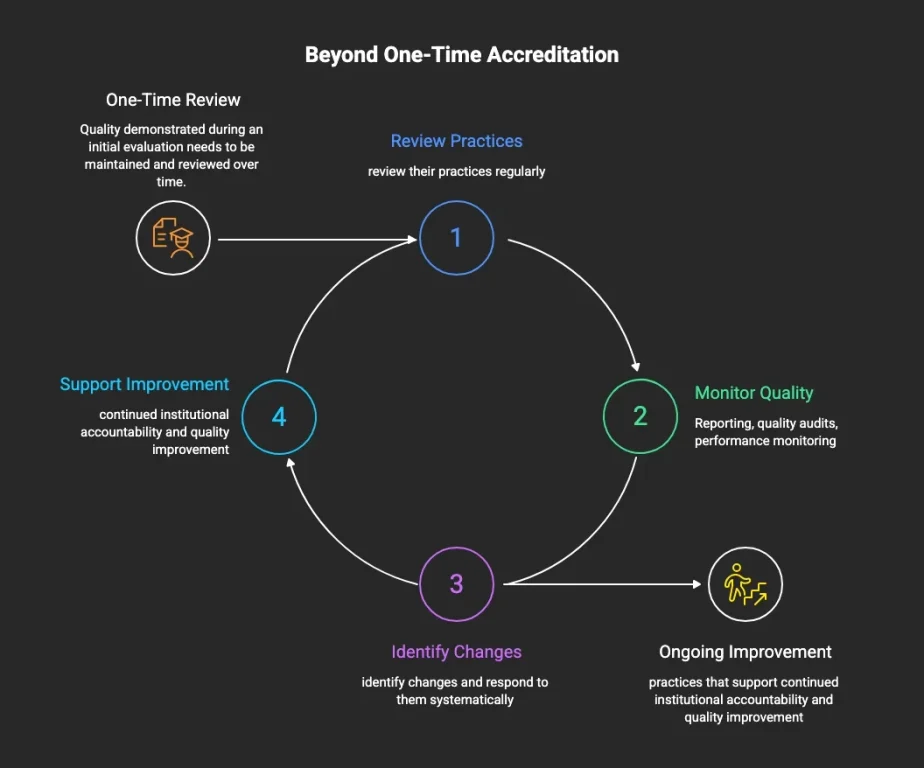
This means that the quality demonstrated during an initial evaluation needs to be maintained and reviewed over time. Without ongoing monitoring, systems that were appropriate at one stage of institutional development may gradually become less effective or less aligned with current needs.
Continuous quality assurance addresses this challenge by creating opportunities for institutions to review their practices regularly. Reporting, quality audits, performance monitoring, benchmarking, and improvement activities can help institutions identify changes and respond to them systematically.
For organizations considering Institutional Accreditation Services, this distinction is important. Accreditation should not be approached only as a process of obtaining recognition. It can also provide a framework for establishing practices that support continued institutional accountability and quality improvement.
Building an Integrated Quality Assurance Ecosystem
A strong quality assurance system does not operate through one isolated activity. Institutional quality depends on the relationship between governance, academic programs, assessment, faculty, learner support, documentation, and internal monitoring.
An integrated Quality Assurance Ecosystem brings these areas together. Governance provides accountability and establishes how decisions are made. Curriculum determines what learners are expected to achieve. Assessment provides evidence of learning and competency. Internal quality assurance helps institutions review whether these systems are functioning effectively.
When these elements operate together, quality assurance becomes part of institutional management rather than an activity performed only before an external review. Institutions can use information gathered through regular reporting and evaluation to understand their performance and identify areas that may require attention.
Annual Institutional Reporting
Regular institutional reporting can help maintain continuity between formal accreditation reviews. Instead of gathering information only when an institution is preparing for an evaluation, annual reporting encourages organizations to maintain accurate records and remain engaged with their quality responsibilities.
Institutional reporting can provide an opportunity to review developments within the organization, including changes to programs, academic activities, institutional processes, and quality systems. Maintaining this information consistently can also make it easier for institutions to identify areas that require further review.
Within a continuing quality assurance framework, reporting is not simply an administrative requirement. It can provide a structured record of institutional development and support ongoing accountability.
Periodic Quality Audits
Periodic quality audits provide another mechanism for reviewing institutional practices after accreditation. While an initial accreditation evaluation establishes whether an institution meets applicable requirements, periodic review can help determine whether those standards continue to be maintained.
Quality audits can examine whether established policies and procedures are being implemented effectively and whether institutional practices remain aligned with the organization’s academic and operational objectives. They can also provide opportunities to identify areas where corrective or improvement measures may be appropriate.
Regular review encourages institutions to treat quality as an active responsibility. Rather than waiting for a future accreditation event to identify weaknesses, institutions can use periodic evaluations to address issues as part of their normal quality management practices.
Performance Benchmarking
Performance benchmarking allows institutions to examine their practices against defined expectations and quality indicators. It provides a structured basis for understanding how effectively institutional systems are performing and where further development may be required.
Benchmarking can be applied to different aspects of institutional activity, depending on the organization’s framework and objectives. Curriculum relevance, learning outcomes, assessment practices, governance processes, documentation, and quality assurance activities can all contribute to an institution’s overall performance.
For educational and training organizations operating in changing professional environments, benchmarking can also support continued relevance. Comparing current practices against established standards can encourage institutions to review whether their programs and systems continue to meet the needs of learners and the sectors they serve.
Continuous Improvement Guidance
Monitoring and evaluation become valuable when institutions use their findings to improve. Continuous improvement involves identifying areas for development, implementing appropriate changes, and reviewing whether those changes have strengthened institutional performance.
This does not mean that every institutional process needs to be changed continuously. Instead, it means creating a structured culture in which evidence and feedback can inform decisions.
Continuous improvement may involve strengthening documentation, updating academic programs, reviewing assessment practices, improving internal procedures, or addressing identified compliance requirements. By approaching improvement systematically, institutions can make changes based on identified needs rather than reacting only when problems become significant.
How This Supports Long-Term Academic Growth
Long-term academic growth requires institutions to expand while maintaining the quality of their educational systems. Growth may involve introducing new programs, reaching new learner groups, adopting new technologies, or responding to emerging professional requirements. Each development can create new quality considerations.
A sustainable quality framework helps institutions manage this growth without losing sight of their core academic responsibilities. Curriculum design, learning outcomes, competency development, assessment methodology, faculty capability, governance, and internal quality assurance need to remain connected as an institution evolves.
This is particularly important for training providers and institutions operating in technical and vocational fields. Industry expectations can change quickly, making curriculum relevance and competency development important components of institutional quality.
An effective quality assurance approach provides opportunities to review whether learning outcomes remain meaningful, whether assessments accurately measure intended competencies, and whether programs continue to reflect relevant professional requirements.
Institutional growth also requires appropriate governance. As organizations become larger or more complex, clear responsibilities and decision-making processes become increasingly important. A strong governance structure can help establish accountability and ensure that institutional decisions remain aligned with academic and organizational objectives.
Through an integrated quality framework, these areas can be considered together rather than managed as separate activities. This allows institutions to pursue growth while continuing to focus on quality, accountability, and learner outcomes.
Institutional Benefits of Sustained Compliance
Maintaining quality standards over time can provide important institutional value. Sustained compliance demonstrates that an organization continues to take its academic and operational responsibilities seriously rather than treating accreditation as a one-time achievement.
For institutions, maintaining established standards can support stronger governance, structured academic processes, consistent assessment practices, and greater transparency. It can also provide a framework for reviewing institutional performance and identifying opportunities for improvement.
IQA-US’s accreditation framework places emphasis on areas including institutional governance, curriculum quality, assessment, quality assurance, academic integrity, and continuing monitoring. Its approach is designed to support educational organizations as they develop their academic and operational systems.
Official recognition can also provide an institutional reference point for demonstrating that an organization has undergone an accreditation process. Within the IQA-US framework, accredited institutions receive a unique ATC Code and can be included within the relevant verification system.
Verification is particularly important in an environment where educational credentials and institutional claims increasingly need to be transparent and accessible. Digital verification mechanisms can allow relevant parties to confirm accreditation or credential information rather than relying solely on documents presented by an institution or individual.
However, institutional credibility is ultimately supported by the quality of the systems behind that recognition. A directory listing, accreditation status, or verification mechanism is most meaningful when it is supported by continuing compliance, responsible governance, appropriate academic practices, and ongoing quality improvement.
Creating a Culture of Continuous Quality Improvement
Sustainable quality assurance ultimately depends on institutional culture. Policies and standards provide structure, but their effectiveness depends on how consistently an institution applies them in everyday operations.
A culture of continuous quality improvement encourages institutional leaders, academic teams, faculty, and administrative staff to view quality as a shared responsibility. Governance teams can monitor institutional performance, academic teams can review curriculum and learning outcomes, and assessment teams can examine whether evaluation methods accurately measure learner achievement.
Regular feedback is also important. Institutions can use information from learners, faculty, assessment activities, audits, reporting, and performance reviews to identify areas that may require attention. When this information is considered systematically, improvement becomes an ongoing part of institutional decision-making.
This approach can also strengthen institutional resilience. Organizations that regularly review their systems are better positioned to respond to changes in educational delivery, technology, industry expectations, and learner needs.
The objective is therefore not to create an endless cycle of audits. It is to establish a practical quality culture in which institutions understand their standards, monitor their performance, identify areas for development, and make informed improvements.
Accreditation as an Ongoing Journey
Sustainable accreditation is ultimately about maintaining a connection between standards and everyday institutional practice. The accreditation process establishes a structured basis for evaluation, while ongoing quality assurance helps institutions maintain and develop the systems that support those standards.
For institutions seeking Institutional Accreditation Services, this ongoing perspective can change how accreditation is approached. Rather than preparing for one review and then returning to normal operations, institutions can incorporate quality assurance into their regular planning, governance, academic development, assessment, and monitoring activities.
A Quality Assurance Ecosystem brings these activities together. Institutional reporting provides continuity, quality audits support review, benchmarking provides performance insight, and continuous improvement helps institutions respond to what they learn.
Over time, this approach can help institutions build stronger academic systems while remaining responsive to changing learner, industry, and educational requirements. Accreditation then becomes more than a formal milestone. It becomes part of a broader institutional commitment to quality, accountability, transparency, and continuous development.
Institutional excellence is not created through a single evaluation. It develops through consistent attention to governance, curriculum, assessment, quality assurance, compliance, and institutional performance.
A sustainable approach to accreditation recognizes that educational quality must evolve alongside the institution itself. By building systems for reporting, review, benchmarking, and continuous improvement, institutions can make quality assurance part of their everyday operations.
For educational organizations, the goal is not simply to achieve accreditation but to build the systems and culture required to sustain quality over time. When accreditation is supported by continuous monitoring and improvement, institutions can create a stronger foundation for responsible growth, academic integrity, and long-term quality.