
Rising Demand for Secure, Remote Competency-Based Evaluation
The growth of digital education has changed how institutions, training providers, and professional academies evaluate learner competency. Online assessments allow candidates to complete examinations remotely while giving institutions greater flexibility in delivering programs across different locations. For competency-based education, this flexibility can make assessment more accessible and easier to manage at scale.
However, moving examinations into a digital environment also creates an important challenge: ensuring that assessment results accurately represent a candidate’s own knowledge, skills, and performance. A secure online examination needs to do more than deliver questions and record answers. It needs appropriate controls for candidate authentication, examination access, assessment conditions, monitoring, evaluation, and result management.
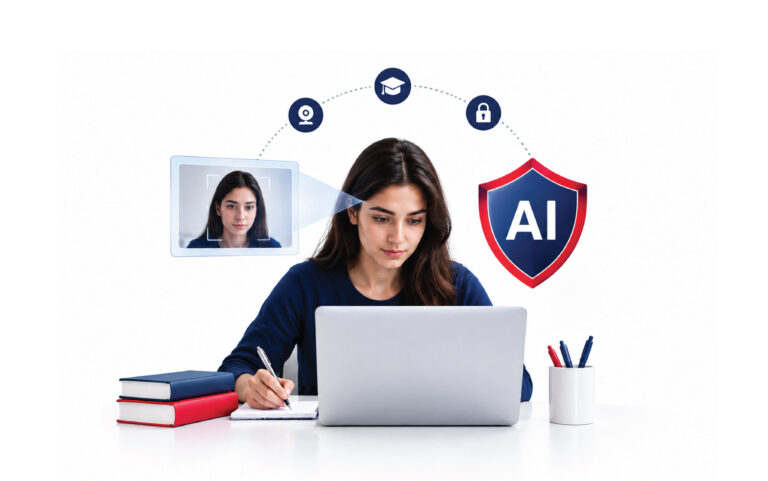
An AI-Enabled Online Assessment System can bring several of these functions together within a structured digital assessment environment. Authentication controls can help establish candidate identity, timed examination controls can provide consistent assessment conditions, monitoring can support examination oversight, and automated grading can streamline the evaluation of suitable questions.
For institutions providing qualifications across different regions, assessment integrity is also closely connected to certification credibility. A certificate represents an achievement, but confidence in that achievement depends partly on the reliability of the process through which the candidate was assessed.
Secure digital assessment can therefore support more than examination management. When assessment procedures are structured, transparent, and appropriately controlled, they can contribute to greater confidence in the qualifications awarded by an institution.
To prevent cheating in online exams, no single tool is enough. Institutions need layered controls: verified login, identity checks, timed conditions, monitoring, and consistent grading. Together these make sure a result reflects the candidate’s own work. This guide covers the main risks of remote assessment and the five controls that address them.
Why online exam security is harder than in-person testing
In an exam hall, you control the room and supervise candidates directly. Remotely, you have to recreate that control through technology and clear rules. Three risks matter most:
- Impersonation: someone other than the registered candidate sits the exam.
- Unauthorized help: other people, notes, messaging apps, or AI tools such as chatbots supply answers.
- Tampering: questions, responses, or results are altered or leaked.
Each risk needs a different control, which is why one feature can’t cover everything.
Which control stops which threat?
| Threat | Control | Limitation |
| Account sharing / unauthorized access | Dual OTP login (email + mobile) | Confirms access, not who is typing |
| Impersonation | Live ID photo verification | Needs clear candidate instructions and privacy handling |
| Extended time or collaboration over time | Timed exam controls | Does not detect outside help |
| Unauthorized help in session | Randomized monitoring snapshots | Provides evidence for review, not proof alone |
| Answer sharing between candidates | Randomized question pools | Needs a large, well-designed question bank |
| Inconsistent marking | Automated grading | Suited to objective and structured questions only |
The 5 controls
1. Dual OTP login
Requiring one-time passwords on both the candidate’s registered email and mobile number ties exam access to verified contact details, not just a password that can be shared. It reduces the risk of someone logging in with another person’s credentials.
2. Live ID photo verification
A live photo captured at the start of the session lets the institution compare the person taking the exam with the registered candidate. It addresses impersonation directly and leaves a visual record for any later review. Tell candidates in advance what is captured and why.
3. Timed exam controls
A fixed duration gives every candidate the same conditions and limits the opportunity to look up answers or consult others over an extended period. Set the time to match the assessment’s design: enough to demonstrate competency, not enough to research every answer. Session start and completion records also support audits and appeals.
4. Randomized monitoring snapshots
Snapshots taken at random points give reviewers a record across the whole session, not just the start. This is lighter than live human proctoring and works for candidates across time zones. Monitoring should be disclosed up front, and image data handled under applicable privacy rules.
5. Randomized question pools and automated grading
Drawing questions from a larger pool means candidates seldom see identical papers, which makes answer sharing less useful. Automated grading then applies the same scoring rules to every candidate and speeds up results for objective questions. Complex written answers and practical demonstrations still need expert human review.
IQA-US’s online assessment system includes dual OTP login, timed controls, AI-assisted question generation, randomized question pools, automated grading, live ID photo verification, and random monitoring snapshots.
How the controls work together
A session runs in sequence: the candidate verifies with OTP, confirms identity with a live photo, sits a timed exam on a randomized question set while snapshots are taken, and is graded by defined criteria. The results go into the candidate’s assessment record. Each stage covers a gap the others leave open.
Balancing security with candidate experience
Strict security fails if honest candidates can’t get through it. Good practice:
- Publish clear instructions on login, time limits, monitoring, and permitted resources before the exam.
- Offer accommodations and accessible formats where required.
- Say what data is collected, why, and how long it is kept.
- Apply the same procedures to every candidate.
Why exam integrity matters for certification
A certificate is only as credible as the assessment behind it. IQA-US’s Program Certification framework evaluates programs against areas including defined learning outcomes, transparent assessment methods, grading criteria, examination procedures, and academic integrity. It also states that its certifications are digitally verifiable through its portal, so employers and institutions can confirm a credential’s authenticity. Secure assessment shows the learner earned the result, and verification shows the credential is genuine.
Further reading: Program Certification · Student verification · Partner verification