
In today’s competitive training and education market, learners, employers, and institutional partners increasingly look beyond course titles and marketing claims. They want to know whether a training provider follows credible standards, maintains proper academic and operational systems, and can provide qualifications that are easy to verify. For training centers seeking to establish stronger institutional credibility, formal accreditation can provide an important framework for demonstrating their commitment to quality.
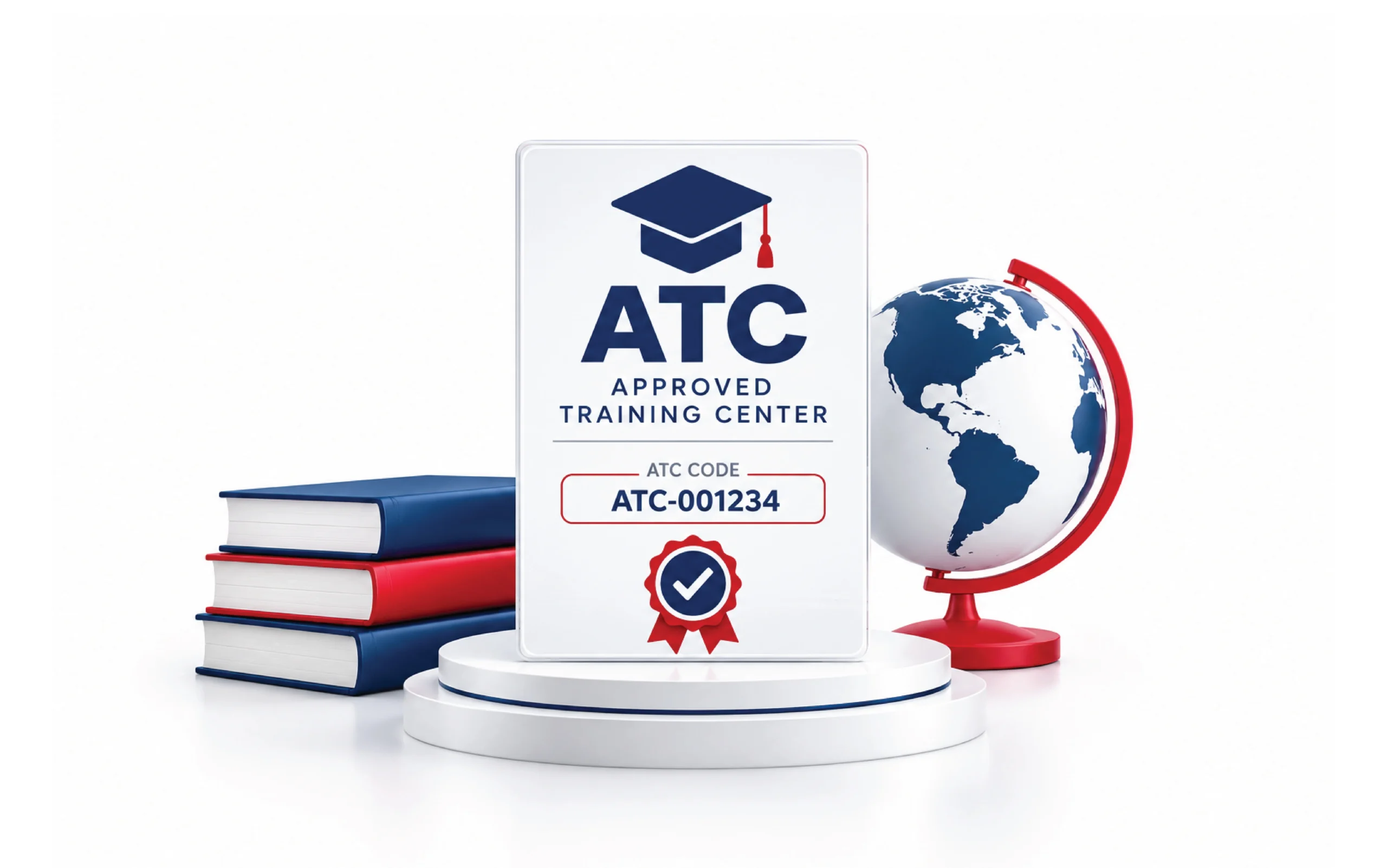
One element associated with this process is the Approved Training Center (ATC) Code. An ATC Code provides an accredited training institution with a unique institutional identifier that can be used for certificate issuance, verification, and recognition within the relevant accreditation system.
For training center owners and academy leaders, understanding the strategic value of an ATC Code is important. It is not simply another number attached to an institution. When supported by a structured accreditation process, it can contribute to institutional identity, verification, operational credibility, and trust-building.
What Is an Approved Training Center (ATC) Code?
An Approved Training Center (ATC) Code is a unique identification number associated with an institution accredited by IQA-US. It is issued after the institution successfully completes the accreditation process and is used as an institutional reference for activities such as certificate issuance and status verification.
The code helps connect the training center to the accreditation and verification framework. Rather than relying only on claims made by an institution itself, learners, employers, and other stakeholders can use the relevant verification system to check institutional information.
This creates an important distinction between simply describing a training center as “approved” and having an identifiable accreditation status that can be verified through an established system.
An ATC Code can therefore serve as part of a training provider’s institutional identity. It provides a reference point through which accreditation status and related information can be connected to the organization.
However, it is important to understand what an ATC Code does not represent. Accreditation by an independent accreditation body is different from government licensing or statutory approval. An ATC Code does not automatically replace local regulatory requirements, professional licensing, or other legal permissions that may apply to a particular educational or training activity.
Its strategic value comes from its role within a structured accreditation and verification framework.
How Is an ATC Code Obtained?
An ATC Code is not normally obtained as a standalone registration. It is connected to the successful completion of the accreditation process.
For a training institution, the process begins with an application. The institution provides information about its organization, programs, governance, trainers or faculty, facilities, assessment practices, and other relevant operational areas.
The documentation and standards evaluation then examines areas such as curriculum design, learning outcomes, competency mapping, assessment methodology, grading systems, internal quality assurance, and operational practices.
The quality and compliance assessment is another important stage. Accreditation is not simply about whether an institution offers courses. It involves evaluating whether the organization has appropriate systems for delivering and assessing those programs in a structured manner.
Once the required evaluation has been completed and the institution meets the applicable requirements, an accreditation decision can be made. Following approval, the institution can receive its accreditation documentation and ATC Code.
This process gives the code greater meaning than a basic membership number or marketing identifier. It is connected to an institutional evaluation process.
Why Does an ATC Code Matter to Training Providers?
Training providers operate in a market where trust can strongly influence how learners and partners evaluate institutions. A recognizable and verifiable accreditation status can help a training center communicate that it has undergone an external review against defined standards.
The value is particularly relevant for institutions that want to move beyond informal course delivery and establish a more structured academic or professional identity.
Building Institutional Credibility
One of the most immediate strategic benefits of accreditation is the opportunity to strengthen institutional credibility.
A training center can have excellent trainers and useful courses, but prospective learners may still have difficulty determining how the institution manages quality, assessment, documentation, and certification.
An accreditation framework introduces an additional layer of external evaluation.
An ATC Code can then provide an identifiable reference connected to that accreditation status. Instead of relying entirely on promotional statements, the institution can direct stakeholders toward a verification process.
For learners, this can make institutional information easier to validate. For partners, it can provide another point of reference when evaluating a training provider.
The code itself does not guarantee the quality of every individual course or the success of every learner. Its significance comes from the accreditation framework and the systems that support it.
Supporting Transparent Verification
Verification has become increasingly important in modern education and professional training.
As certificates move from paper-based records toward digital credentials, institutions need reliable ways to demonstrate that qualifications are genuine. Employers and other stakeholders may need to verify whether a certificate was actually issued by an institution and whether the associated accreditation or certification information is valid.
An ATC Code contributes to this institutional verification structure. IQA-US provides digital verification systems through which accreditation and certification information can be checked.
This can be particularly valuable when a training provider issues certificates to learners across different locations. Digital verification reduces dependence on physical documents and makes it easier for authorized stakeholders to confirm relevant information.
For training centers, this also supports a more professional approach to credential management.
Strengthening Operational Systems
Accreditation can encourage institutions to examine the systems behind their training operations.
Areas such as curriculum alignment, learning outcomes, competency mapping, assessment integrity, faculty credentials, internal quality assurance, and documentation become part of a structured quality framework.
This can help institutions identify gaps that may otherwise remain unnoticed.
The strategic benefit is therefore not limited to external recognition. The accreditation process can also encourage internal improvement.
For example, a training center may review whether its learning outcomes are clearly defined, whether assessments properly measure those outcomes, whether grading procedures are consistent, and whether institutional records are maintained appropriately.
These systems can support a more organized learning environment and provide a stronger foundation for future development.
ATC Accreditation and Partnership Opportunities
Training centers often want to expand their networks through collaborations with other educational organizations, professional bodies, employers, and training partners.
An accreditation status can contribute to how an institution presents itself during such discussions. A verifiable institutional identity and documented quality framework can provide useful evidence when potential partners assess an organization.
However, an ATC Code should not be presented as an automatic qualification for partnerships. Each organization makes its own decisions based on factors such as program relevance, reputation, commercial requirements, regulatory conditions, and quality standards.
The strategic advantage is that an accredited institution has an additional credential it can present during those conversations.
This can support a more structured institutional profile, particularly for training providers seeking to demonstrate that their operations have been reviewed against defined standards.
Supporting Growth Through Trust
Business growth in education depends on more than attracting new learners. Training providers also need to establish trust, maintain relationships, demonstrate professionalism, and deliver consistent learning experiences.
An ATC Code can support this broader trust-building process by giving an institution a recognizable and verifiable accreditation identifier.
For a prospective learner comparing multiple training centers, verifiability can become one factor in the decision-making process.
For an employer evaluating a certificate, access to verification can provide greater confidence that the credential can be authenticated.
For an institutional partner, accreditation documentation can contribute to the overall assessment of a potential collaborator.
None of these outcomes should be treated as guaranteed. Instead, they represent ways in which accreditation and verification can strengthen the institutional foundation from which a training provider develops its reputation.
Digital Credentials and the ATC Code
The role of accreditation is increasingly connected to digital credential systems.
Modern certification platforms can allow institutions to issue secure digital certificates containing unique identification or verification information. Third parties can then use an online portal to validate relevant credentials.
The ATC Code operates at the institutional level, while individual certificates can have their own verification identifiers.
This creates a useful distinction. The ATC Code helps identify the accredited training institution, while individual credential information can help verify a particular learner’s achievement.
Together, these systems can create a more transparent approach to credential management.
For training providers, this can also reduce dependence on certificates that are difficult to authenticate or maintain manually.
Maintaining Accredited Status
Obtaining an ATC Code should not be viewed as the final step in quality management.
Accreditation is associated with continued compliance and institutional improvement. IQA-US describes ongoing monitoring through activities such as annual reporting, periodic review, benchmarking, and continuous improvement.
This means accredited institutions should continue maintaining appropriate documentation, assessment practices, academic integrity, and operational standards.
The current IQA-US framework also distinguishes between the ongoing accreditation status and the physical accreditation certificate. Accreditation is described as remaining valid subject to continued compliance, while the physical accreditation certificate is issued for a defined period and renewed according to the applicable requirements.
For training center leaders, this highlights an important principle: accreditation should become part of the institution’s quality culture rather than being treated only as a marketing badge.
ATC Code vs. Government Licensing
Training providers should also understand the difference between accreditation and licensing.
Government licensing or statutory approval is generally concerned with whether an organization is legally permitted to operate under applicable laws and regulations. Accreditation, by contrast, evaluates an institution against the standards established by the accrediting organization.
An ATC Code therefore should not be described as a government license unless a separate government authority has specifically issued such authorization.
This distinction is important for responsible communication. Training providers can confidently explain their accreditation status while still recognizing the separate legal and regulatory requirements that may apply to their operations.
Clear communication helps protect institutional credibility and prevents learners from misunderstanding what accreditation represents.
How to Apply for ATC Accreditation
For training center owners considering accreditation, the process can be approached systematically.
The first step is to review the accreditation requirements and determine whether the institution is ready to provide the required organizational and academic information.
The next step is to submit the application with accurate details about the institution, its programs, governance structure, faculty or trainers, facilities, and assessment systems.
Documentation should then be prepared carefully. This may include curriculum information, learning outcomes, competency mapping, assessment procedures, grading systems, internal quality assurance processes, and relevant institutional records.
The institution then proceeds through the applicable evaluation stages. Reviewers assess the submitted information and determine whether the institution meets the required standards.
If gaps are identified, the institution may need to address them before the accreditation decision is finalized.
Once the institution successfully completes the accreditation process, the accreditation documentation and ATC Code can be issued according to the applicable procedure.
After approval, the institution can use its accreditation status and authorized branding in accordance with the relevant guidelines. It can also make use of verification systems to help stakeholders authenticate its institutional and certification information.
Preparing for Accreditation
Training center leaders can improve their readiness by treating accreditation preparation as an institutional quality exercise rather than simply an application requirement.
Start by reviewing the organization’s governance and documentation. Ensure that responsibilities are clearly defined and that important records can be produced when required.
Next, review every major program. Check whether learning outcomes are clearly stated, whether course content supports those outcomes, and whether assessments actually measure the required competencies.
Trainer and faculty credentials should also be organized and maintained accurately.
Assessment integrity deserves particular attention. Institutions should have clear procedures for candidate identification, examination conduct, grading, record keeping, and protection against malpractice.
Finally, review internal quality assurance. A strong institution should have mechanisms for collecting feedback, monitoring performance, identifying weaknesses, and implementing improvements.
These preparations can make the accreditation process more manageable while also strengthening the institution’s long-term operations.
The Strategic Value Goes Beyond the Code
An ATC Code is valuable because of what it represents within a broader accreditation system.
For training providers, the real strategic opportunity lies in building an institution that can demonstrate structured governance, relevant programs, reliable assessment, responsible certification, and continuous quality improvement.
The code provides an identifiable connection to that framework.
In a market where learners increasingly want confidence in the institutions behind their qualifications, verifiability can become an important part of institutional communication. A training center that can clearly explain its accreditation status, provide appropriate verification pathways, and maintain transparent quality processes is better positioned to build informed trust.
At the same time, accreditation should always be communicated accurately. It does not guarantee employment, salary increases, business revenue, visa approval, or automatic recognition by every government or organization. Its value lies in the standards, evaluation, verification, and quality framework it provides.
For academy leaders considering the next stage of institutional development, that distinction matters.
An Approved Training Center Code is not simply a number to place on promotional material. It can form part of a broader strategy for institutional credibility, transparent certification, operational improvement, and trust-building.
When accreditation is supported by genuine quality practices, the ATC Code becomes one visible part of a much larger commitment: building a training institution that learners, employers, and partners can understand, evaluate, and verify.
In Short
The training and education landscape is becoming increasingly focused on quality, transparency, and verifiable credentials. For training center owners and academy leaders, formal accreditation can provide a structured way to demonstrate commitment to these principles.
An Approved Training Center (ATC) Code gives an accredited institution a unique identifier connected to its accreditation and verification framework. It can support institutional credibility, digital verification, certificate management, operational development, and professional positioning.
Obtaining the code begins with the accreditation process: submitting an application, providing institutional and program documentation, undergoing quality and compliance evaluation, addressing applicable requirements, and receiving approval.
The most important consideration is to view ATC accreditation as more than a branding exercise. Its long-term value comes from the quality systems, transparency, assessment integrity, and continuous improvement practices behind the accreditation.
For training providers ready to strengthen their institutional standing and establish a more structured approach to quality and verification, the next step is to understand the accreditation requirements and application process.