
Higher education has traditionally measured success through grades, examinations, qualifications, and degree completion. These measures remain important, but they do not always capture the full range of capabilities students need to develop during their educational journey. Academic knowledge is only one part of preparing learners for the challenges of professional and personal life.
Students also need opportunities to develop resilience, emotional awareness, communication skills, practical competencies, ethical judgment, and the ability to adapt to changing professional environments. This broader perspective has increased attention on holistic development as an important complement to academic learning.
A Holistic Development Framework can help institutions organize this broader approach. Rather than treating personal wellbeing, practical skills, and career preparation as unrelated activities, institutions can connect them through defined learning pathways and outcomes.
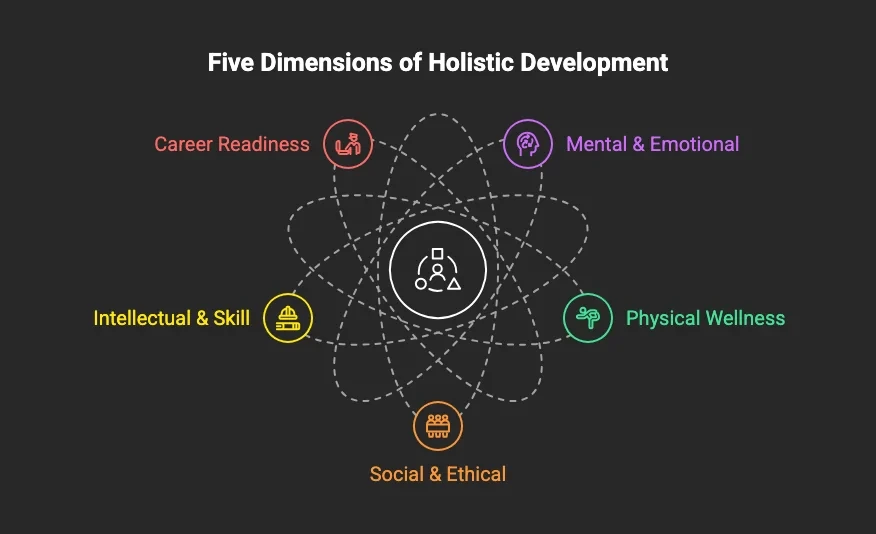
The current IQA-US Wellness & Holistic Development Framework provides one example of this approach. It integrates mental, emotional, physical, social, and professional development into structured learning pathways and identifies five dimensions: Mental & Emotional, Physical Wellness, Social & Ethical, Intellectual & Skill, and Career Readiness.
The objective is not to move away from academic achievement. Instead, holistic development can strengthen the educational experience by helping students connect what they learn with how they live, work, communicate, and contribute.
The Case for Holistic Development
A student’s development does not stop when an examination ends. Higher education can also be a period in which learners develop confidence, independence, problem-solving abilities, social awareness, and professional direction.
A broader educational model recognizes these different dimensions of development. It gives institutions an opportunity to consider whether students are not only acquiring knowledge but also developing the capabilities needed to apply that knowledge effectively.
This does not mean adding disconnected activities to an already demanding curriculum. A more effective approach is to identify meaningful areas of development and incorporate them into structured learning pathways.
The IQA-US framework, for example, identifies balanced personal and professional growth, mental resilience, emotional intelligence, social responsibility, and ethical values among its objectives.
For higher education providers, this type of framework can offer a useful reference point for thinking about learner development beyond conventional academic measures.
Mental and emotional wellbeing
Mental and emotional wellbeing can have an important place within a broader educational experience. Students may encounter academic pressure, deadlines, examinations, new responsibilities, and uncertainty about their future careers. Developing the ability to understand and manage these challenges can complement their academic preparation.
Mental resilience and emotional intelligence are specifically identified within the holistic development framework. These areas encourage institutions to consider capabilities such as self-awareness, emotional understanding, and resilience alongside academic knowledge.
Higher education institutions can support this dimension through appropriate learning activities, reflective exercises, wellbeing-focused modules, mentoring, and other structured experiences. The purpose is not to replace academic learning with wellbeing programs. Instead, wellbeing can become one part of a broader educational pathway.
This approach can also help students recognize that professional readiness involves more than technical knowledge. The ability to respond to challenges, communicate effectively, and maintain personal balance can be relevant throughout both education and working life.
Physical development
Physical wellness is another area that can easily receive less attention when educational success is primarily measured through academic performance.
Students spend substantial time studying, completing assignments, attending classes, and working with digital technologies. Developing awareness of healthy routines and personal wellbeing can therefore complement intellectual development.
Physical Wellness is one of the five dimensions identified within the IQA-US holistic development framework. The organization also lists Health & Wellness Management as a structured 100-hour online/blended program, with learning areas including mental wellbeing practices, lifestyle improvement, and workplace wellness concepts.
For institutions, physical development does not necessarily need to compete with academic subjects. It can be incorporated through complementary modules, learning activities, and structured pathways that help learners understand the relationship between wellbeing and sustainable personal development.
A whole-person approach allows physical wellness to be considered alongside academic and professional objectives rather than treating it as entirely separate from education.
Social skills
Knowledge becomes increasingly valuable when learners can apply it while communicating and working with others. Higher education therefore has an opportunity to develop social capabilities alongside academic competencies.
Teamwork, communication, social responsibility, ethical awareness, and collaboration can all contribute to a learner’s ability to participate effectively in professional and community environments.
The Social & Ethical dimension of the framework specifically recognizes social responsibility and ethical values.
These capabilities can be developed through collaborative assignments, group projects, practical learning, community-oriented activities, and experiences that require students to make decisions with others in mind.
Social development also gives students opportunities to move beyond purely individual achievement. Learning how to listen, collaborate, communicate, and act responsibly can help connect classroom learning with the realities of professional and social life.
Professional readiness
Academic qualifications can provide an important foundation, but professional environments also require people to apply knowledge, solve problems, communicate, adapt, and demonstrate practical capabilities.
Career Readiness is therefore included as one of the five dimensions of the IQA-US Wellness & Holistic Development Framework. The organization’s curriculum services also emphasize competency-based qualification frameworks, learning-outcome mapping, industry-demand alignment, modular course structures, and practical workplace learning.
This creates an opportunity for institutions to introduce career-related development throughout the educational journey rather than treating professional preparation as something that begins only after graduation.
The focus should be on developing relevant capabilities and measurable learning outcomes, not promising a particular employment result. Students can instead be encouraged to understand how their academic knowledge connects with practical skills and professional expectations.
Practical Skills for Global Career Readiness
Holistic development becomes more meaningful when students have opportunities to develop practical skills alongside their academic studies. Supplementary learning pathways can help learners explore competencies that complement their primary field of study.
Personal branding is one example. Students may have strong academic knowledge but still need to understand how to communicate their capabilities in professional and digital environments. Digital Marketing & Personal Branding is one of the structured programs listed by IQA-US, with learning areas including social media strategy, performance tracking, and online presence development.
Entrepreneurship can provide another practical pathway. Entrepreneurship & Business Fundamentals is also listed among the organization’s programs, with areas including business model design, financial literacy, innovation, and problem-solving.
These skills can complement academic study by giving learners exposure to practical decision-making and real-world applications. They can also help students understand how different competencies work together rather than viewing knowledge as something limited to a single subject.
Digital capabilities are another growing area of professional development. Applied AI, for example, can introduce learners to emerging tools while also encouraging consideration of responsible technology use. The IQA-US program portfolio includes Prompt Engineering & Applied AI, with outcomes covering generative AI fundamentals, writing and optimization techniques, and ethical AI usage.
The broader principle is that practical learning should have a clear purpose. Institutions can identify relevant skills, connect them with learning outcomes, and provide learners with opportunities to demonstrate what they have developed.
Structuring Holistic Pathways Alongside Academics
Integrating holistic development does not require institutions to replace their existing academic programs. Instead, institutions can identify complementary development areas and build them into structured pathways alongside established academic learning.
The first step is understanding which capabilities are relevant to the institution’s learners and educational objectives. A Holistic Development Framework can provide a structure for organizing these areas.
The five dimensions identified by IQA-US Mental & Emotional, Physical Wellness, Social & Ethical, Intellectual & Skill, and Career Readiness illustrate how different aspects of learner development can be brought together within one framework.
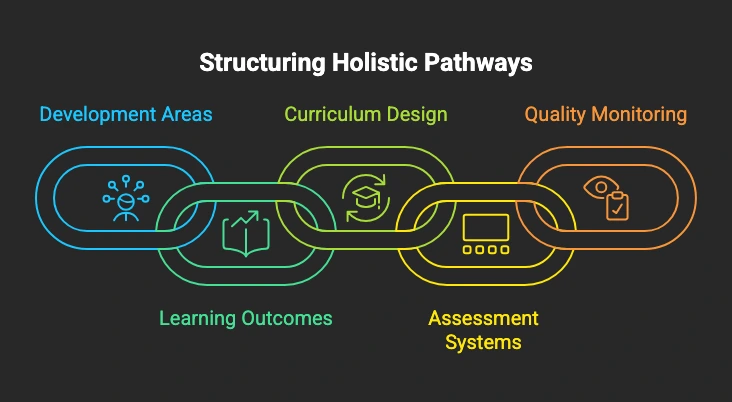
The next step is connecting these areas with clear learning outcomes. This helps prevent holistic development from becoming a collection of unrelated workshops or extracurricular activities.
Curriculum design is particularly important. Competency-based qualification frameworks, learning-outcome mapping, benchmarks, modular course structures, assessment planning, and practical workplace learning can help institutions connect broader development with formal educational processes. These are among the curriculum development services currently described by IQA-US.
Assessment also matters. If institutions expect students to develop competencies beyond conventional subject knowledge, they need appropriate ways to evaluate progress.
Digital assessment systems can support structured evaluation where appropriate. The current IQA-US assessment system includes features such as dual-OTP login, timed examination controls, randomized question pools, AI-assisted question generation, expert-curated question banks, automated grading, live ID photo verification, and random monitoring snapshots.
Quality monitoring can then help institutions review whether their learning pathways continue to meet defined standards. This creates a more connected process in which curriculum, learning outcomes, assessment, and quality improvement support one another.
The Learner Impact
For learners, holistic development can create a broader educational experience in which academic knowledge is supported by personal, social, practical, and professional development.
The impact becomes clearer when these capabilities are defined and measurable. Students should be able to understand not only what subjects they have studied but also which competencies they have developed and how those competencies can be demonstrated.
This is where certification and verification can provide additional value. Structured assessment can provide evidence that a learner has completed defined learning and demonstrated particular competencies.
International Certification & Verification can further support this process by making credentials digitally verifiable. IQA-US currently describes its certifications as digitally verifiable, with unique verification codes and online verification for employers. Its Student Benefits page also highlights competency-based assessment, measurable learning outcomes, skill validation, and digital credential verification.
The value of verification is not simply the existence of another certificate. A credential becomes more useful when there is a clear process for authenticating it and understanding what learning or competencies it represents.
The learner impact can therefore extend across several stages: developing knowledge, gaining practical experience, demonstrating competencies through assessment, and maintaining evidence of completed learning.
This broader view supports learner success by recognizing that education can involve more than academic performance alone. Students can work toward becoming capable, adaptable, responsible, and professionally prepared individuals while continuing to pursue academic excellence.
For institutions, the challenge is to make this broader development intentional rather than accidental. Clear frameworks, learning outcomes, practical pathways, appropriate assessment, and quality processes can help create a more consistent approach.
The result is not necessarily a different type of degree. Instead, it is a more comprehensive educational experience in which academic learning and broader development can reinforce each other.
Higher education institutions seeking to strengthen these pathways can consider how curriculum design, competency mapping, assessment, quality assurance, and certification can work together around their own educational objectives.
Request Advisory Support to explore how a structured quality and holistic development approach can be aligned with your institution’s curriculum, learning outcomes, and development goals.