
The expansion of online and remote education has changed how institutions teach, assess, and certify learners. Examinations that once required students to gather in controlled physical environments can now be delivered through secure digital platforms, allowing learners to complete assessments from different locations. This flexibility has made online assessment an important part of modern education, professional training, and competency-based learning.
However, the transition from physical examination halls to digital environments also creates new challenges for academic integrity. In a traditional examination setting, invigilators can directly observe candidates, verify identities, control examination materials, and respond to unusual activity. In an online environment, much of this oversight must be supported through technology, clearly defined procedures, and responsible assessment design.
Artificial intelligence and digital security controls can help institutions address some of these challenges. AI-assisted question generation, identity verification, randomized question selection, examination monitoring, secure authentication, and digital reporting can create a more controlled assessment environment. When these technologies are implemented responsibly, they can strengthen the reliability of examination results without making technology the sole decision-maker in academic matters.
For academic administrators, examination boards, and online education providers, the objective is not simply to make online examinations harder to compromise. It is to create assessment systems where learners can demonstrate genuine knowledge and skills, institutions can maintain confidence in results, and qualifications can be supported by transparent and verifiable assessment processes.
Why Academic Integrity Is More Challenging in Online Examinations
Academic integrity means that an assessment result should genuinely represent the knowledge, skills, and performance of the individual being assessed. Online examinations can make this principle more difficult to protect because institutions have less direct control over the environment in which an examination takes place.
A learner may complete an examination from a home, office, library, or another remote location. The institution may not have the same level of visibility that would exist in a supervised examination room. Additional devices, reference materials, communication platforms, or assistance from another person may potentially be available during the assessment.
Identity verification is another important consideration. In a physical examination, an invigilator can compare the candidate with an approved identity document or registration record. Remote assessment requires digital mechanisms to establish a reasonable connection between the registered candidate and the person completing the examination.
There is also a broader issue of trust. An examination result may contribute to a qualification, certification, professional opportunity, or further education. If stakeholders cannot trust the process through which the result was produced, confidence in the qualification can be affected.
This does not mean that online examinations are inherently less credible than physical examinations. Rather, it means that digital assessments require appropriately designed safeguards. Academic integrity needs to be incorporated into the entire assessment process, from candidate authentication and question design to examination monitoring, result processing, data protection, and certification.
Common Risks in Remote Assessment
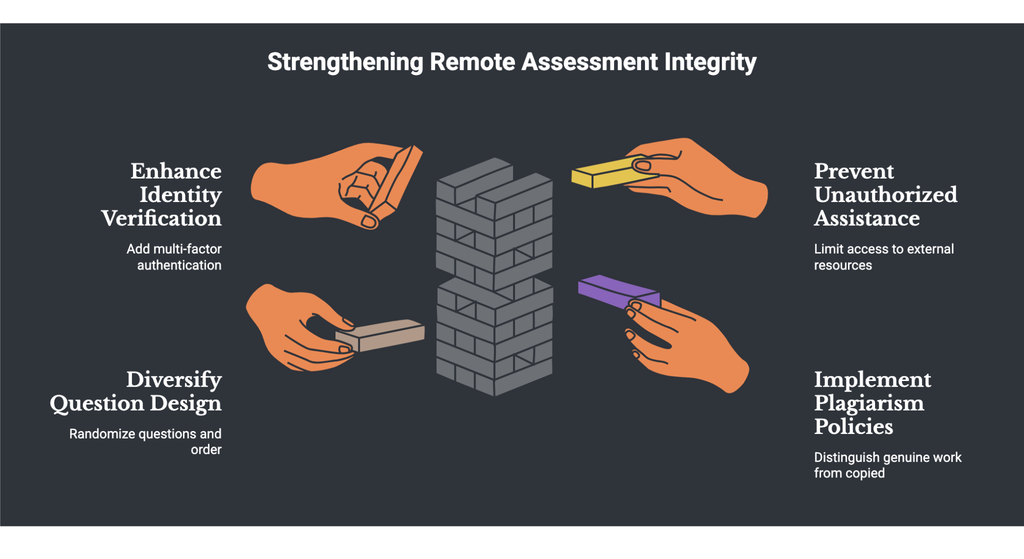
Impersonation is one of the clearest risks associated with remote examinations. If a system relies only on basic login credentials, another person could potentially attempt to complete an assessment on behalf of the registered candidate. Stronger identity verification can help reduce this risk by adding additional authentication requirements.
Unauthorized assistance is another concern. A learner completing an examination remotely may potentially have access to another device, online information, notes, or another person. Even when such activity cannot be directly established, the possibility of unauthorized assistance can undermine confidence in the assessment process.
Question sharing can create another challenge. When every candidate receives exactly the same questions in exactly the same order, opportunities for answer sharing may increase. Assessment design can therefore contribute to academic integrity alongside technological controls.
Plagiarism can also become a concern, particularly in assessments involving written responses or assignments. Institutions need appropriate policies and assessment methods that distinguish genuine learner performance from copied or externally produced work.
Weak authentication, insecure data handling, poor examination design, and insufficient monitoring can collectively create vulnerabilities. A secure online assessment system therefore needs multiple layers of protection rather than relying on a single feature.
How AI-Assisted Assessment Can Strengthen Integrity
Artificial intelligence can contribute to online assessment by supporting question development and creating more flexible examination environments. However, AI should operate within an academic framework rather than replacing subject expertise.
The IQA-US Smart Assessment Framework combines AI-driven tools with expert-designed questions. Its assessment system includes AI-assisted question generation alongside manually curated question banks. This approach allows technology to support the creation of assessment content while retaining expert involvement in evaluating the relevance and quality of questions.
This distinction is important. AI can help institutions generate assessment material efficiently, but academic experts remain essential for determining whether questions accurately measure the intended competencies. A technically sophisticated question is not automatically a good academic question. It needs to be relevant to the learning outcomes, appropriate to the qualification level, and aligned with the knowledge or skills being assessed.
Randomized question selection provides another useful safeguard. Instead of presenting every candidate with an identical question sequence, questions can be selected from structured pools. This can make predictable answer sharing more difficult and create greater variation between examination sessions.
Timed examination controls provide another layer of structure. A defined examination period creates consistency between candidates and limits the opportunity to spend excessive time searching for unauthorized assistance.
Together, these measures demonstrate that AI and digital technology can support academic integrity through both assessment content and examination controls.
Identity Verification in Secure Online Assessment
A secure online examination begins with confidence that the correct person is taking the examination.
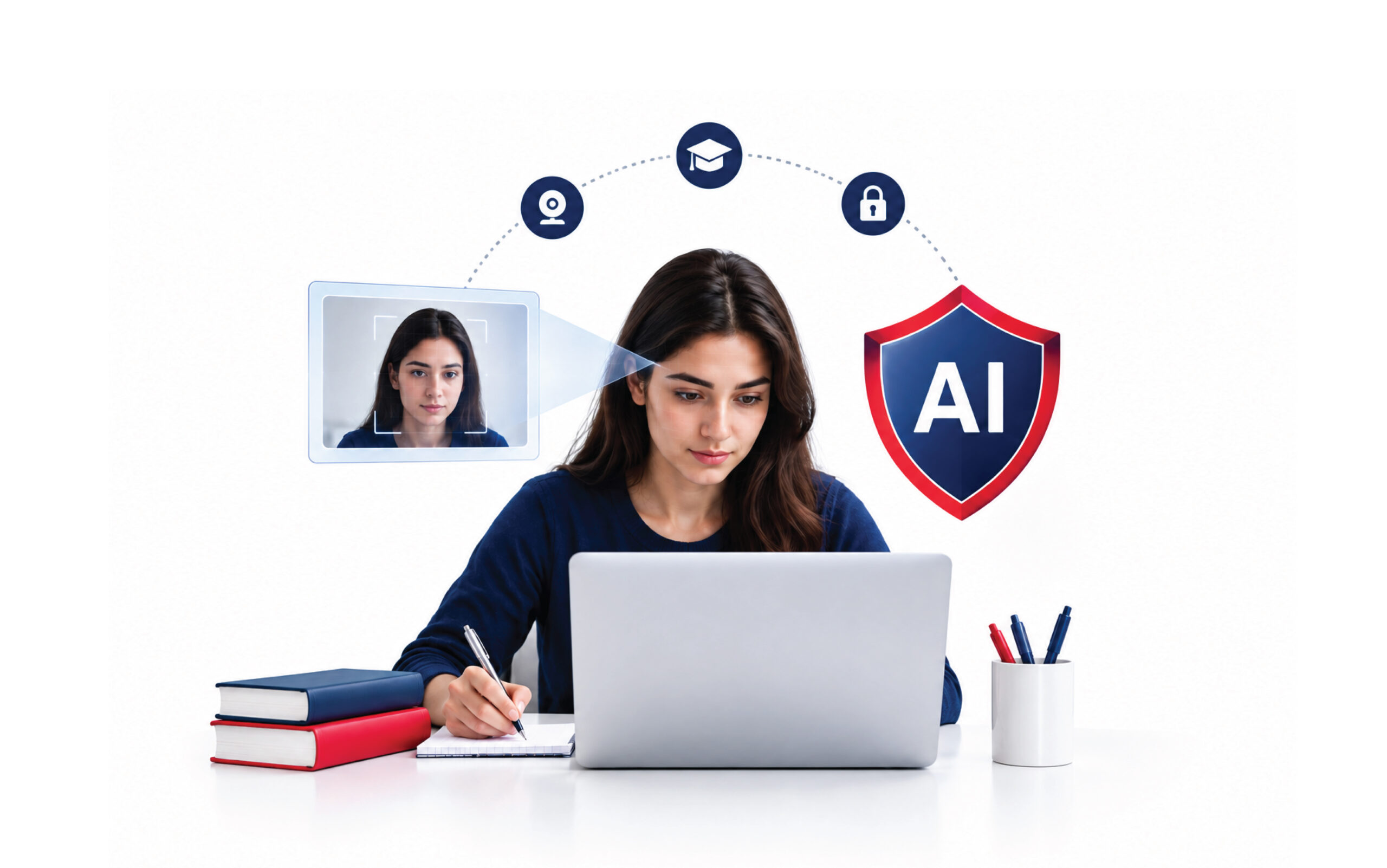
IQA-US’s online examination system includes email and mobile OTP verification, creating an additional authentication layer beyond ordinary login credentials. The platform also includes live photo capture during examinations. These measures help establish a stronger connection between the candidate’s verified identity and the assessment session.
Identity verification is particularly important when assessments lead to formal certification. If a qualification is intended to demonstrate that an individual has achieved specific competencies, institutions need appropriate safeguards to ensure that the assessment belongs to the person whose name appears on the resulting record.
Verification should also be considered as part of the wider certification process. IQA-US states that certification is issued only after verification, supporting the principle that the credential should be connected to a verified assessment outcome.
This approach strengthens the chain of trust from candidate authentication to examination performance and ultimately to certification.
Monitoring Without Replacing Human Judgment
Online examination monitoring can provide institutions with additional information about an assessment session. IQA-US’s Smart Assessment Portal includes random snapshots throughout an examination session as part of its security and integrity standards.
Monitoring can help create an additional record of examination activity, but it should be treated as one component of a wider integrity framework. Technology should not automatically transform every unusual event into a finding of misconduct.
A candidate may experience technical problems, interruptions, accessibility requirements, or circumstances that affect their examination environment. An unusual event therefore needs to be considered within context.
Human review remains important when academic integrity concerns arise. Technology can provide information and evidence, while institutional policies and qualified academic personnel should determine how that information is interpreted.
This balance is especially important when institutions describe their systems as AI-enabled. The presence of AI does not eliminate the need for academic governance. Instead, responsible AI implementation requires clear policies defining how automated tools are used and how academic decisions are ultimately made.
Protecting Student Privacy
Online examination security should never be separated from data protection.
Identity verification and monitoring may involve sensitive candidate information. Examination systems can process identity details, examination records, photographs, performance information, and other assessment-related data. Institutions therefore need to understand what information is collected, why it is required, who can access it, and how it is protected.
IQA-US addresses these considerations through its Privacy Policy. The policy states that candidate identity information and examination data are collected for operational and compliance purposes, including assessment administration, certification issuance, verification services, and compliance monitoring.
The policy also states that examination identity verification information, such as photo capture during examinations, is securely stored for audit and compliance purposes. IQA-US describes secure digital storage, restricted administrative access, encrypted authentication processes, and controlled verification systems as part of its data-security approach.
These measures illustrate an important principle for online education providers: stronger examination security should be accompanied by responsible information governance.
Students should also receive clear information about the technology used during an assessment. Transparency helps learners understand why identity verification or monitoring is required and how their information will be handled.
Data collection should be proportionate to the purpose of the assessment. Institutions should avoid treating surveillance as an objective in itself. The objective should remain the protection of assessment integrity while respecting legitimate privacy expectations.
Fairness and Responsible Implementation
Security controls must be implemented in a way that supports fairness.
Different learners may have different technical environments, internet connections, devices, accessibility requirements, or approved accommodations. A secure examination system should recognize these differences rather than assuming that every candidate has identical circumstances.
Institutions should therefore establish clear examination policies before implementing AI or digital controls. Candidates should understand the authentication process, examination rules, permitted resources, monitoring requirements, and procedures for reporting technical problems.
Fairness also requires consistency. The same examination standards should be applied to candidates in comparable circumstances, while legitimate accommodations should be handled through defined institutional procedures.
IQA-US’s governance framework places emphasis on fairness, objectivity, transparency, and responsible oversight. Its Review Panel evaluates assessment systems and provides recommendations, while its Code of Conduct requires institutions to conduct assessments fairly, protect student data, and uphold academic integrity. Candidates are expected to complete examinations independently and avoid malpractice or external assistance.
This governance approach reinforces the idea that technology should operate within a clearly defined academic and ethical framework.
Building a Layered Examination Security Model
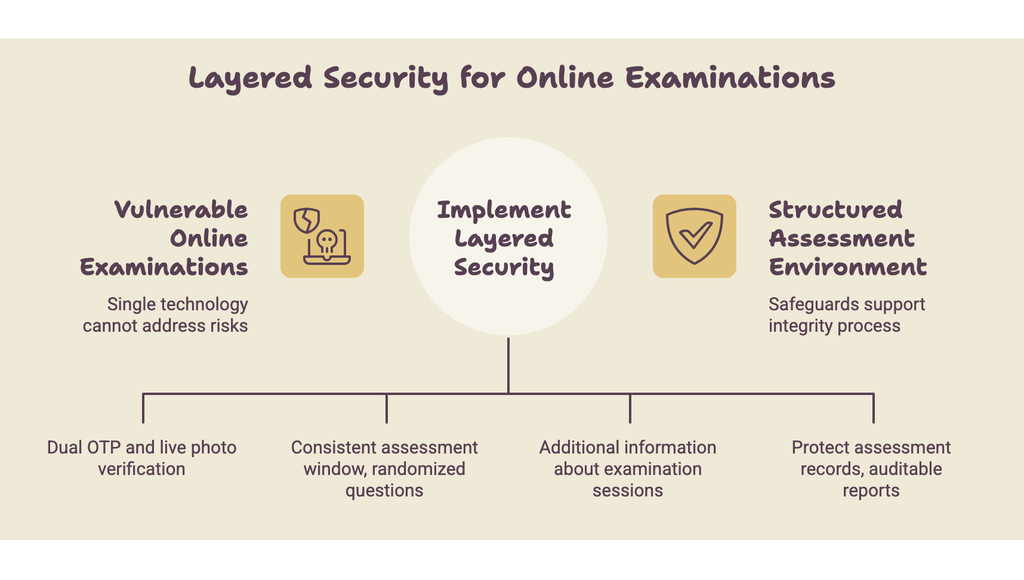
No single technology can address every online examination risk. Effective academic integrity depends on multiple controls working together.
A secure online assessment environment can begin with strong authentication. Dual OTP verification can strengthen candidate access, while live photo verification can provide an additional identity record. Timed examination controls can create a consistent assessment window, while randomized question pools can reduce predictable answer sharing.
Monitoring mechanisms can provide additional information about examination sessions. Secure data storage can protect assessment records, while structured reports can create an auditable record of candidate performance.
IQA-US’s online assessment platform brings several of these controls together. Its stated features include secure login, dual OTP verification, timed examinations, AI-assisted question generation, expert-curated question banks, randomized question pools, automated grading, live ID photo verification, random monitoring snapshots, and secure data storage.
This layered approach is more reliable than depending on a single AI feature. Authentication addresses identity, assessment design addresses question security, monitoring supports examination oversight, and secure storage protects records.
The result is a more structured assessment environment in which different safeguards support different parts of the integrity process.
Best Practices for AI Exam Controls
Responsible implementation should begin with the purpose of the assessment. Institutions should identify the risks associated with a particular examination before selecting technological controls. A high-stakes professional assessment may require stronger identity and monitoring measures than a low-stakes formative assessment.
The second consideration is alignment between technology and learning outcomes. Security should not make an examination unnecessarily complicated or interfere with the actual competencies being assessed. AI-assisted questions should be reviewed by appropriate subject experts to ensure accuracy, relevance, difficulty, and alignment with the qualification.
Institutions should also establish clear rules for candidates. Requirements for identity verification, permitted resources, external assistance, examination duration, and monitoring should be communicated before the examination begins.
Data protection should form part of implementation planning. Institutions should understand what candidate information is being collected, how it is stored, how access is controlled, and how long records are retained.
Human oversight should remain present throughout the process. Automated tools can support question development, authentication, monitoring, grading, and reporting, but institutional policies should determine how academic integrity concerns are evaluated.
Finally, examination controls should be reviewed regularly. Online education and digital assessment continue to evolve, and new technologies can create new risks as well as new opportunities. Continuous review helps institutions identify weaknesses, improve procedures, and maintain confidence in assessment systems.
Creating Trustworthy Online Examinations
Academic integrity is ultimately about trust.
Students need confidence that their achievements are assessed fairly. Institutions need confidence that examination results represent genuine performance. Employers and other stakeholders need confidence that qualifications represent the knowledge and competencies they claim to demonstrate.
Secure online assessment can support this trust when technology is combined with appropriate academic governance.
IQA-US places assessment integrity within its wider quality assurance framework. Its accreditation process evaluates assessment methodology, grading systems, assessment security, academic integrity, certification validation, and ethical governance. Its broader framework also emphasizes structured digital assessment systems, secure authentication, transparent grading, performance tracking, and secure verification.
The future of online examinations should therefore not be viewed as a choice between technology and human oversight. The strongest approach combines both. AI-assisted assessment can increase efficiency and support more dynamic examination design, while secure authentication, monitoring, expert review, privacy safeguards, and institutional governance help ensure that technology serves the purpose of credible education.
As remote learning and digital certification continue to develop, maintaining academic integrity will remain essential. Institutions that build secure, transparent, and responsibly governed online assessment systems can protect the credibility of their examinations while giving learners a fair opportunity to demonstrate what they genuinely know and can do.