

The world of work is changing rapidly. New technologies, evolving business models, automation, digital transformation, and changing employer expectations are reshaping the skills required across industries. For Technical and Vocational Education and Training (TVET) institutions, this creates a clear challenge: curricula must prepare learners for the skills employers need today while remaining adaptable enough to respond to tomorrow’s workforce demands.
The scale of the challenge is significant. According to the World Economic Forum’s Future of Jobs Report 2025, 63% of employers identify skills gaps as a major barrier to business transformation between 2025 and 2030. The report also projects that 39% of workers’ existing skill sets will be transformed or become outdated during the same period. These findings highlight why traditional approaches to vocational curriculum development may no longer be sufficient.
Industry-aligned TVET curriculum design provides a practical way to address this challenge. By connecting learning outcomes, technical competencies, assessment methods, and practical training with genuine workforce requirements, institutions can create programs that are more relevant, responsive, and focused on competency development.
Understanding the Gap Between TVET and Industry Demands
Traditional TVET curricula can become disconnected from industry when they are based primarily on established academic structures rather than current occupational requirements. Technical fields can change faster than formal curriculum review cycles, creating a gap between what learners are taught and what employers expect them to be able to do.
This gap can appear in several ways. Training may place too much emphasis on theoretical knowledge while providing insufficient opportunities for practical application. Equipment, software, technologies, or processes used in training may not reflect current workplace environments. Assessment methods may measure knowledge without adequately demonstrating whether learners can perform occupational tasks. Soft skills such as communication, teamwork, adaptability, and problem-solving may also receive less attention than technical knowledge.
An industry-aligned curriculum begins by recognizing that employability depends on more than completing a course. Learners need to demonstrate competencies that are relevant to the occupations and environments they are preparing to enter.
Why Industry Alignment Matters
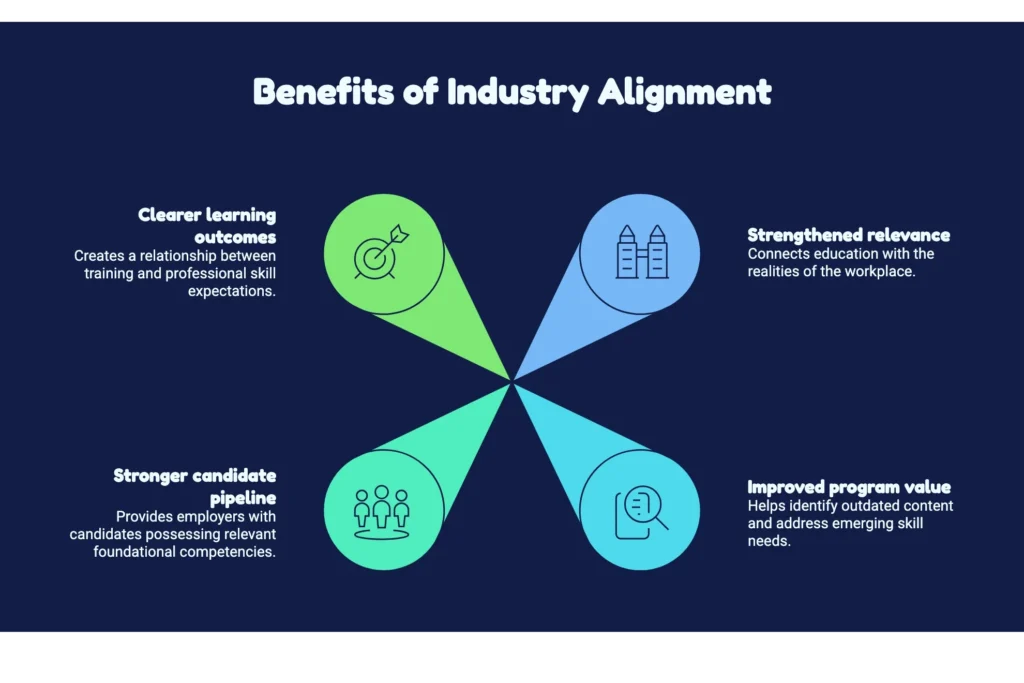
Industry alignment helps TVET institutions connect education with the realities of the workplace. Instead of designing programs solely around subjects or modules, institutions can focus on the knowledge, skills, and competencies learners need to perform effectively in occupational settings.
This approach can strengthen the relevance of training and provide a clearer connection between learning outcomes and workforce requirements. It can also help institutions identify outdated content, address emerging skill needs, and improve the practical value of their programs.
For employers, better-aligned training can contribute to a stronger pipeline of candidates with relevant foundational competencies. For learners, it can create a clearer relationship between what they learn during training and the skills expected in professional environments.
IQA-US places industry relevance among the objectives of its accreditation approach, emphasizing alignment between curricula and current workforce requirements and a focus on tangible competency development. Its program certification framework also evaluates whether programs consider current workforce needs, skill gaps, industry expectations, and measurable learning outcomes.
Principles of Effective TVET Curriculum Design
Connecting Curriculum Development with Industry Requirements
Effective curriculum design should begin with an understanding of the occupation and the environment in which learners are expected to work. Institutions can gather information from employers, occupational standards, professional bodies, labor-market information, industry publications, and technology trends.
Employer consultation is particularly valuable because businesses can provide practical insight into the competencies required for specific roles. Their input can help institutions understand which technical skills are essential, which workplace behaviors matter, and where graduates commonly experience difficulties when transitioning into employment.
Rather than treating industry consultation as a one-time exercise, institutions can establish ongoing mechanisms for collecting employer feedback. This allows curriculum teams to identify changes in technologies, processes, regulations, and workplace expectations and consider them during curriculum reviews.
Mapping Industry Skills to Learning Outcomes
Once industry requirements are identified, they should be translated into clear learning outcomes. Skills mapping creates a connection between occupational requirements and what learners are expected to demonstrate by the end of a program.
For example, if an industry requires technicians to diagnose technical problems, the curriculum should not only teach the underlying theory. It should also provide opportunities for learners to interpret information, identify faults, apply troubleshooting procedures, and demonstrate appropriate solutions.
Learning outcomes should therefore describe observable competencies rather than simply listing topics. Clear outcomes make it easier for curriculum designers to determine what should be taught, how it should be practiced, and how achievement should be assessed.
IQA-US’s accreditation and program certification frameworks emphasize measurable learning outcomes and competency-based evaluation. Its curriculum development services also include learning outcome mapping and benchmarking, competency-based qualification frameworks, and alignment with industry demand and skill gaps.
Integrating Real-World and Practical Application
TVET education is strongly connected to practical performance. Learners need opportunities to apply concepts in realistic environments rather than relying entirely on classroom instruction.
Practical workshops, simulations, projects, demonstrations, workplace learning, and industry-based activities can help learners develop confidence and technical competence. The specific approach will depend on the occupation, available facilities, safety requirements, and industry context.
A well-designed practical component should mirror relevant workplace tasks as closely as appropriate. Learners should be able to practice procedures, use relevant tools and technologies, solve problems, and demonstrate their ability to apply knowledge in realistic situations.
IQA-US specifically identifies practical and theoretical balance as part of its program certification evaluation. Its curriculum development services also include practical workplace learning and modular course structures designed around competency development.
Designing Assessment Around Competency
Curriculum alignment should extend beyond teaching content to assessment. A program may contain relevant subjects and practical activities, but if assessments measure only memorization, they may not provide sufficient evidence of workplace readiness.
Competency-based assessment focuses on whether learners can demonstrate the required skills and apply their knowledge appropriately. Depending on the field, this may involve practical demonstrations, projects, simulations, performance tasks, structured examinations, portfolios, or other forms of evidence.
Assessment criteria should be transparent and connected directly to the intended learning outcomes. Learners should understand what successful performance looks like, while institutions should have reliable methods for determining whether competencies have been achieved.
IQA-US’s program certification framework evaluates assessment methodology, competency-based evaluation, structured grading criteria, transparent examination procedures, and certification requirements. This creates a quality-focused connection between curriculum objectives, learner performance, and assessment.
Keeping Curricula Current in Fast-Changing Technical Fields
Industry alignment is not a one-time curriculum design activity. Technical fields can evolve rapidly, making continuous review essential.
Institutions can monitor changes in technology, occupational standards, employer expectations, regulations, and labor-market requirements. Regular curriculum reviews can then identify areas where content needs to be updated, expanded, removed, or reorganized.
Technology-focused programs may require particular attention because tools and processes can change quickly. Areas such as artificial intelligence, cybersecurity, data technologies, automation, advanced manufacturing, and digital systems are examples of fields where skills requirements continue to develop.
The World Economic Forum’s Future of Jobs Report 2025 identifies AI and big data, networks and cybersecurity, and technological literacy among the fastest-growing technology-related skills. It also highlights analytical thinking, resilience, flexibility, adaptability, creative thinking, and lifelong learning as important capabilities for the changing workforce.
The objective is not to continuously replace entire curricula. Instead, institutions can build review mechanisms that allow relevant components to evolve while maintaining a stable competency framework.
IQA-US supports this approach through quality assurance processes that include periodic quality audits, annual institutional reporting, performance benchmarking, and continuous improvement guidance. Its program certification framework also provides for periodic review to help ensure continued compliance, quality, and industry relevance.
The Role of Industry Partnerships and Employer Collaboration
Strong relationships between TVET institutions and employers can significantly improve curriculum relevance. Industry partners can contribute more than occasional guest lectures or placement opportunities. They can participate in curriculum consultation, competency identification, practical training, project development, assessment design, and program review.
Employer feedback can help institutions understand which competencies are most valuable in actual workplace settings. Industry professionals can also provide insight into emerging technologies and operational practices that may not yet be fully reflected in conventional training materials.
Partnerships can take different forms depending on the institution and occupation. Advisory groups, employer consultations, workplace visits, internships, apprenticeships, industry projects, guest instruction, equipment partnerships, and joint curriculum reviews can all create meaningful connections between education and employment environments.
The most effective partnerships are structured around mutual value. Institutions gain current industry insight, while employers gain opportunities to contribute to the development of future talent and strengthen connections with the education and training system.
Developing Technical and Transferable Skills Together
Workforce-ready TVET programs should combine occupational competencies with transferable capabilities. Technical knowledge remains essential, but modern workplaces also require people who can communicate clearly, collaborate with others, solve problems, adapt to change, and continue learning.
The World Economic Forum’s findings reinforce the importance of combining technical and human capabilities. As technologies change, workers increasingly need both digital or technical skills and capabilities that support effective decision-making, collaboration, adaptability, and continuous development.
Curriculum designers can integrate these competencies into technical learning rather than treating them as completely separate subjects. For example, a technical project can require learners to work in teams, communicate findings, manage tasks, solve unexpected problems, and document their work.
This integrated approach makes transferable skills part of actual occupational performance rather than an additional theoretical component of the curriculum.
Supporting Trainer and Faculty Competence
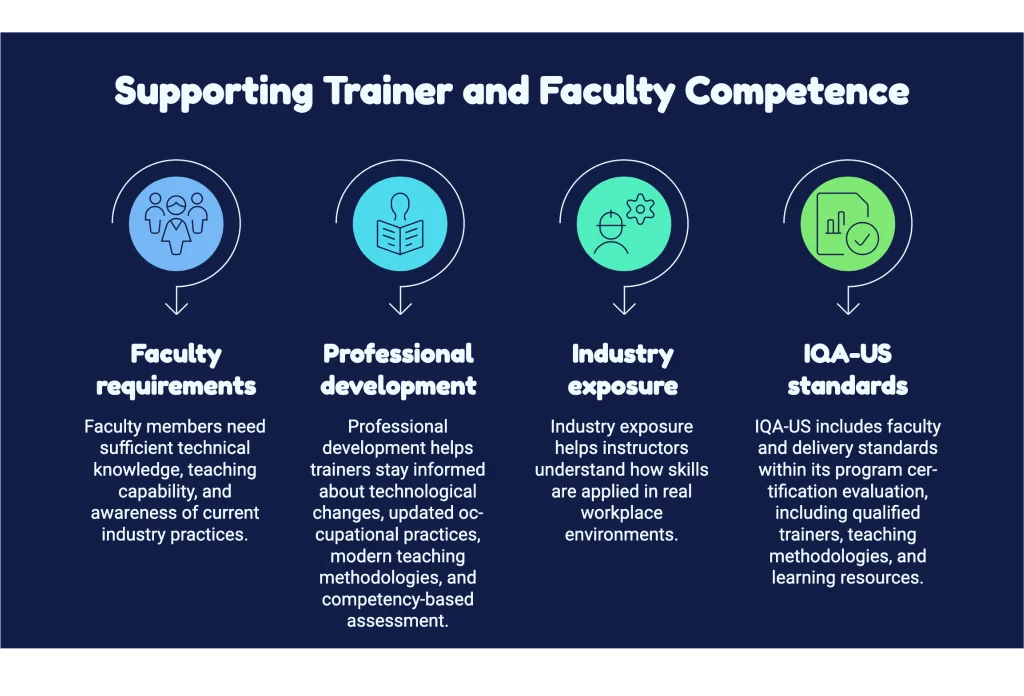
Even a well-designed curriculum depends on capable trainers and instructors for effective implementation. Faculty members need sufficient technical knowledge, teaching capability, and awareness of current industry practices.
Professional development can help trainers stay informed about technological changes, updated occupational practices, modern teaching methodologies, and competency-based assessment. Industry exposure can also help instructors understand how skills are applied in real workplace environments.
IQA-US includes faculty and delivery standards within its program certification evaluation, including qualified trainers and instructors, teaching methodologies, and adequacy of learning resources. This reflects the importance of ensuring that curriculum quality is supported by effective delivery.
Quality Assurance and Continuous Improvement
Industry alignment should be supported by a broader quality assurance system. Curriculum design, teaching, assessment, governance, and continuous improvement need to work together rather than operate as isolated processes.
Institutions can establish review cycles that examine learner performance, assessment outcomes, employer feedback, trainer observations, program data, and changes in industry requirements. The findings can then inform improvements to curriculum content, learning activities, assessment methods, resources, and delivery practices.
Documentation is also important. Clearly defined learning outcomes, curriculum structures, assessment criteria, review procedures, and improvement actions provide evidence that the institution is actively managing program quality.
IQA-US‘s quality assurance framework emphasizes areas such as measurable learning outcomes, competency-based evaluation, transparency in assessment and accreditation, institutional accountability, and continuous improvement. Its benchmarking methodology includes documentation review, learning outcome mapping, assessment analysis, governance evaluation, and compliance verification.
Outcomes of Well-Aligned TVET Programs
A well-aligned TVET curriculum can create stronger connections between education and the workforce. Learners receive opportunities to develop competencies that reflect occupational requirements, while institutions gain clearer mechanisms for evaluating whether their programs remain relevant.
Industry-aligned programs can also contribute to addressing skills gaps by focusing training on competencies that employers actually require. Practical learning and performance-based assessment can provide stronger evidence of what learners are capable of doing, while regular curriculum review can help prevent programs from becoming outdated.
For learners, this can strengthen the relevance of their education and support their transition into professional environments. However, curriculum alignment should not be presented as a guarantee of employment or a specific career outcome. Employment depends on many factors, including individual performance, labor-market conditions, experience, employer requirements, and economic circumstances.
The role of a high-quality TVET program is to provide a strong foundation of relevant knowledge, practical skills, and demonstrable competencies that can support learners as they enter and progress through changing workplaces.
Building Workforce-Ready Curricula for the Future
The future of TVET depends on how effectively institutions connect education with the realities of work. As technologies evolve and employers face changing skill requirements, curriculum design must become more responsive, evidence-based, and focused on demonstrable competencies.
Industry-aligned vocational training begins with understanding workforce requirements and translating those requirements into clear learning outcomes. It continues through practical learning, competency-based assessment, qualified trainers, employer collaboration, and regular curriculum review. Together, these elements create a structured approach to developing programs that remain relevant while supporting continuous improvement.
For TVET leaders, curriculum designers, and workforce development bodies, the priority is not simply to add new technologies or update individual subjects. It is to create a system in which industry requirements are consistently reflected in curriculum planning, delivery, assessment, and quality assurance.
IQA-US provides accreditation, program certification, and curriculum development services that support institutions in strengthening these areas. Its approach emphasizes industry relevance, competency development, measurable learning outcomes, practical application, assessment quality, and continuous improvement.
As the modern workforce continues to change, TVET institutions that build strong connections with industry and regularly evaluate their programs will be better positioned to develop relevant, competency-focused education.