
Institutional excellence is built through more than a single evaluation or accreditation certificate. For educational institutions and training providers, maintaining quality requires consistent attention to governance, curriculum design, assessment practices, learner outcomes, and internal quality assurance. As institutions expand their programs and adopt new delivery models, having structured systems in place becomes increasingly important.
This is where institutional accreditation services can provide a structured framework for evaluating an institution’s academic and operational practices. Accreditation allows institutions to demonstrate how their systems are organized, how quality is maintained, and how educational programs are designed and delivered.
Rather than viewing accreditation as a one-time achievement, institutions can approach it as a structured quality-assurance journey. Each stage provides an opportunity to examine existing practices, identify areas that require attention, and establish stronger foundations for sustainable institutional quality.
For institutions seeking to strengthen their operations, the focus is not simply on receiving accreditation. It is on developing systems that support accountability, consistency, transparency, and continuous improvement.
What Institutional Accreditation Services Evaluate
Institutional accreditation examines the broader systems that support an institution’s ability to deliver education and training effectively. While individual programs are important, institutional quality also depends on the governance structures, curriculum frameworks, assessment systems, and internal processes supporting those programs.
A comprehensive evaluation therefore considers how different parts of an institution work together. Governance establishes accountability, curriculum determines what learners are expected to achieve, assessment provides evidence of learning, and internal quality assurance helps institutions monitor and improve their practices.
Governance Structures
Effective governance provides the foundation for institutional accountability. An institution needs clearly defined leadership, responsibilities, policies, and operational structures to ensure that academic and administrative decisions are managed consistently.
Within the IQA-US accreditation framework, institutions are expected to demonstrate an appropriate organizational structure and leadership. Institutional documentation forms an important part of the evaluation, helping establish how the organization is governed and how its academic and operational responsibilities are managed.
Governance is also closely connected with regulatory and ethical considerations. Clear policies and defined responsibilities can help institutions establish more consistent approaches to decision-making, documentation, academic administration, and quality management.
This is where institutional governance advisory becomes relevant as a broader quality consideration. Strong governance should not exist separately from academic quality. Instead, institutional policies and leadership structures should support the effective delivery, monitoring, and improvement of educational programs.
Curriculum Alignment
A well-designed curriculum provides a clear connection between learning objectives, learner competencies, and the knowledge or skills required within a particular field.
Curriculum design and competency mapping form part of the quality considerations within the IQA-US accreditation framework. Institutions need to demonstrate that their programs have clearly defined learning outcomes and an appropriate structure for delivering those outcomes.
For professional and vocational education providers, curriculum relevance is particularly important. Programs should reflect the knowledge and competencies learners are expected to develop, while remaining appropriate to the educational and professional context in which they are delivered.
Curriculum alignment also provides a basis for evaluating whether assessment methods appropriately measure the intended learning outcomes. When curriculum, learning outcomes, competencies, and assessment are connected, institutions can create a more coherent learning framework.
Assessment Methodologies
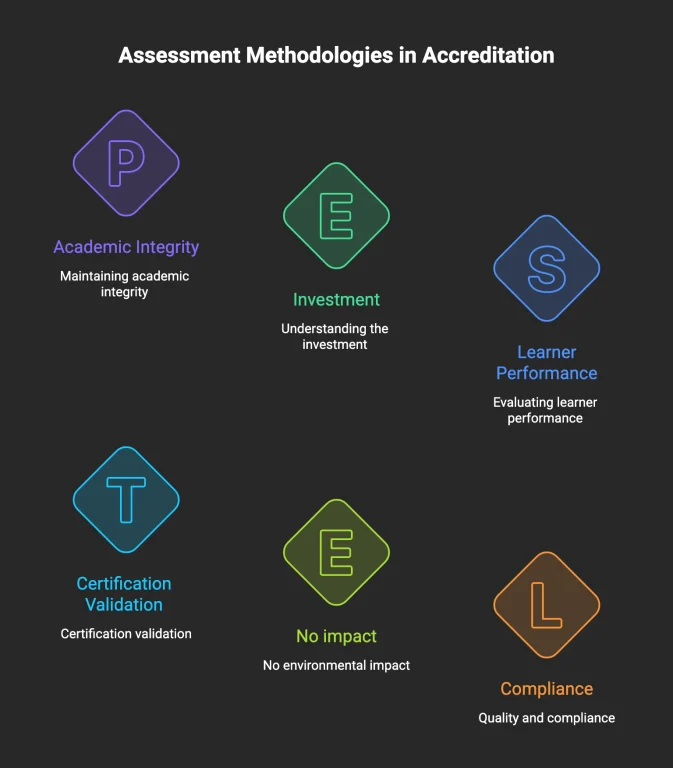
Assessment is an essential part of demonstrating whether learners have achieved the intended outcomes of a program. A strong institutional framework therefore requires assessment methodologies that are clearly defined and consistently applied.
The IQA-US accreditation process considers assessment methodology and grading systems during the documentation and standards evaluation stage. Assessment security and certification validation are also considered within the quality and compliance assessment.
For institutions, this means assessment should not be treated simply as the final step in a course. It should form part of an organized academic system that establishes how learner performance is evaluated and documented.
Clearly defined assessment procedures can also strengthen institutional consistency. When grading approaches, assessment requirements, and relevant procedures are documented, institutions have a stronger foundation for maintaining academic integrity and accountability.
Internal Quality Assurance Systems
External accreditation provides an independent evaluation of institutional practices, but sustainable quality also depends on an institution’s own internal systems.
Internal quality assurance enables institutions to monitor their academic and operational practices, review performance, identify areas requiring improvement, and maintain consistency as the organization develops.
Within the IQA-US framework, internal quality assurance forms part of the institutional documentation and standards evaluation. Documentation, compliance systems, academic processes, and accountability are important elements in establishing how an institution maintains quality.
This internal approach becomes particularly important as institutions introduce new programs, expand their delivery methods, or serve a growing learner population. A structured quality system allows institutions to review their practices continuously rather than waiting until an external evaluation identifies an issue.
Inside the Multi-Stage Accreditation Process
Institutional accreditation is most effective when the process is structured and transparent. A multi-stage approach allows an institution to move from initial eligibility through detailed documentation and quality evaluation before reaching an accreditation decision.
The IQA-US accreditation framework follows a staged process covering institutional application and eligibility, documentation and standards evaluation, quality and compliance assessment, accreditation decision and certification, and monitoring and continuous improvement.
The process begins with the institutional application and eligibility review. At this stage, the institution provides relevant information and documentation required for the initial evaluation. This can include information relating to the institution’s legal status, governance structure, academic programs, faculty, learning resources, curriculum, and assessment systems. The purpose is to establish whether the institution meets the initial requirements to proceed with accreditation evaluation.
The next stage focuses on documentation and standards evaluation. Here, institutional documentation is reviewed in greater detail. Curriculum design, learning outcomes, competency mapping, industry relevance, assessment methodologies, grading systems, and internal quality-assurance practices form part of the areas considered. This stage allows the evaluation to examine how an institution’s systems are structured and documented.
The process then moves into quality and compliance assessment. This stage considers broader areas of institutional quality, including academic integrity, competency-based education, assessment security, certification validation, regulatory compliance, and ethical governance. Where areas require attention, the evaluation process can provide recommendations for improvement.
Following the evaluation, the accreditation decision and certification stage determines whether the institution has satisfied the applicable requirements. Successful institutions receive accreditation certification and are connected with the relevant verification and certification systems.
Accreditation also involves an ongoing quality dimension. Through monitoring and continuous improvement, institutions are expected to maintain their standards and remain aligned with applicable requirements. This reinforces the idea that accreditation is not simply an endpoint but part of an institution’s continuing approach to quality.
The Strategic Value of an ATC Code
An ATC Code forms an important part of the IQA-US accreditation and verification framework.
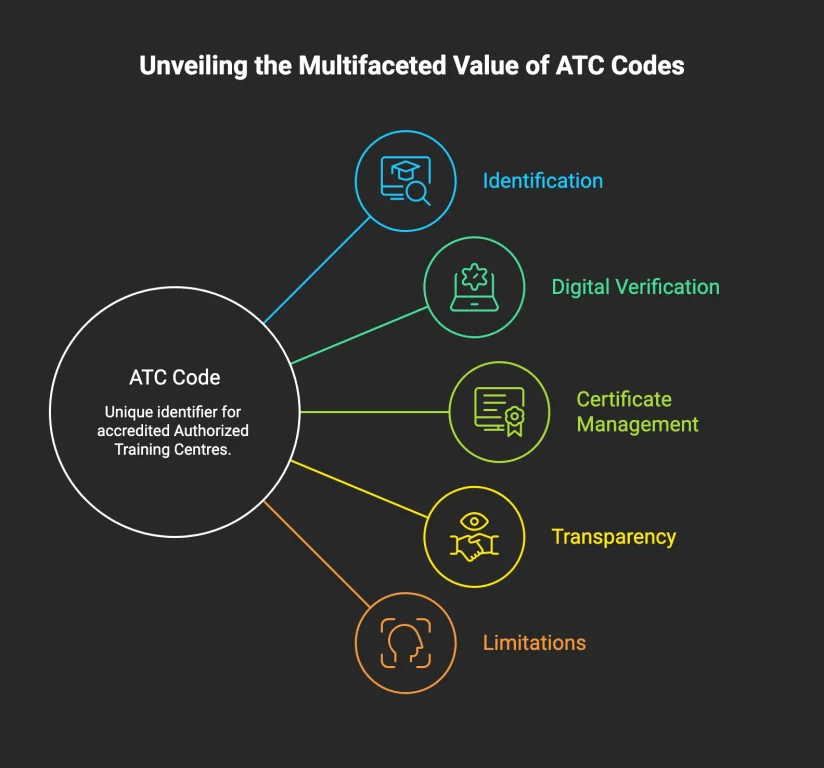
ATC refers to an Authorized Training Centre, and the ATC Code serves as a unique identification number associated with an accredited institution. It provides a way to identify the institution within IQA-US’s verification and certification systems.
For an accredited institution, the ATC Code connects its accreditation status with the organization’s digital verification infrastructure. This provides an additional way for institutional information to be verified rather than relying solely on a physical accreditation document.
The ATC Code is also connected with certificate-related processes. Within the IQA-US framework, accredited institutions use the relevant systems for certificate application, management, and verification.
The value of such a system lies in transparency. As education becomes increasingly digital and institutions operate across different markets, having identifiable and verifiable accreditation information can make it easier to communicate institutional status.
However, the ATC Code should be understood specifically within the IQA-US accreditation framework. It should not be presented as automatically providing government licensing, professional licensing, employment eligibility, or universal recognition unless such recognition is separately granted by the relevant authority.
Digital Listing and International Positioning
Digital verification has become an increasingly important component of institutional transparency. Educational organizations increasingly operate across physical and online environments, making accessible verification systems valuable for communicating institutional and credential information.
IQA-US provides digital verification infrastructure for accredited institutions and certificates. Approved institutions can be associated with a digital verification listing, while certificate verification provides a mechanism for checking relevant credential information.
This creates an additional layer of transparency around accreditation. Instead of relying only on printed documents, institutional and credential information can be connected to a digital system.
For institutions serving international learners or operating across borders, digital verification can also support clearer communication of accreditation status. It provides institutions with a structured way to demonstrate their association with the IQA-US accreditation framework.
Digital positioning should, however, be understood accurately. Accreditation and digital listing do not automatically replace the legal or regulatory requirements of individual countries, professional bodies, licensing authorities, or government agencies. Institutions should continue to comply with the requirements applicable to their location and area of operation.
Understanding the Investment
For institutions considering accreditation, understanding the practical requirements is an important part of the decision-making process. This includes documentation, evaluation requirements, applicable fees, and ongoing compliance expectations.
IQA-US provides information about its accreditation fees and certification-related costs through its official information channels. According to the current published information, the institutional accreditation fee is USD 500, while student certificates issued under IQA-US accreditation carry a USD 10 fee per certificate.
The published information also states that processing generally takes 7 to 10 working days, depending on documentation completeness and evaluation requirements.
Institutions should also understand that accreditation involves continued compliance rather than simply an initial application. IQA-US describes ongoing requirements connected with maintaining accreditation, including reporting, quality review, program updates, and other quality-related activities.
The Financial Protocol provides the relevant information concerning official payment procedures. Institutions should use the official IQA-US financial information when reviewing payment requirements and should avoid relying on unofficial sources for accreditation costs or payment instructions.
Understanding the investment in this way allows institutions to consider accreditation as a structured quality process involving preparation, evaluation, certification, verification, and continued institutional responsibility.
Building Excellence Through Structured Quality Assurance
Institutional excellence does not depend on a single review. It develops when governance, curriculum, assessment, and quality-assurance systems work together as part of a consistent institutional framework.
Strong governance establishes accountability and clear responsibilities. Curriculum alignment connects learning outcomes with relevant competencies. Effective assessment methodologies provide evidence of learner achievement. Internal quality assurance allows institutions to monitor their practices and identify opportunities for improvement.
A structured institutional accreditation process brings these elements together through a sequence of evaluation stages. From initial eligibility and documentation review to quality and compliance assessment, accreditation decision, certification, verification, and continued monitoring, each stage contributes to a broader understanding of institutional quality.
For educational institutions and training providers, the objective is therefore not simply to obtain accreditation. It is to establish systems that support quality, transparency, accountability, and sustainable development.
When institutions treat accreditation as an ongoing commitment to quality rather than a one-time achievement, they can create stronger foundations for learners, educators, administrators, and the wider professional community.