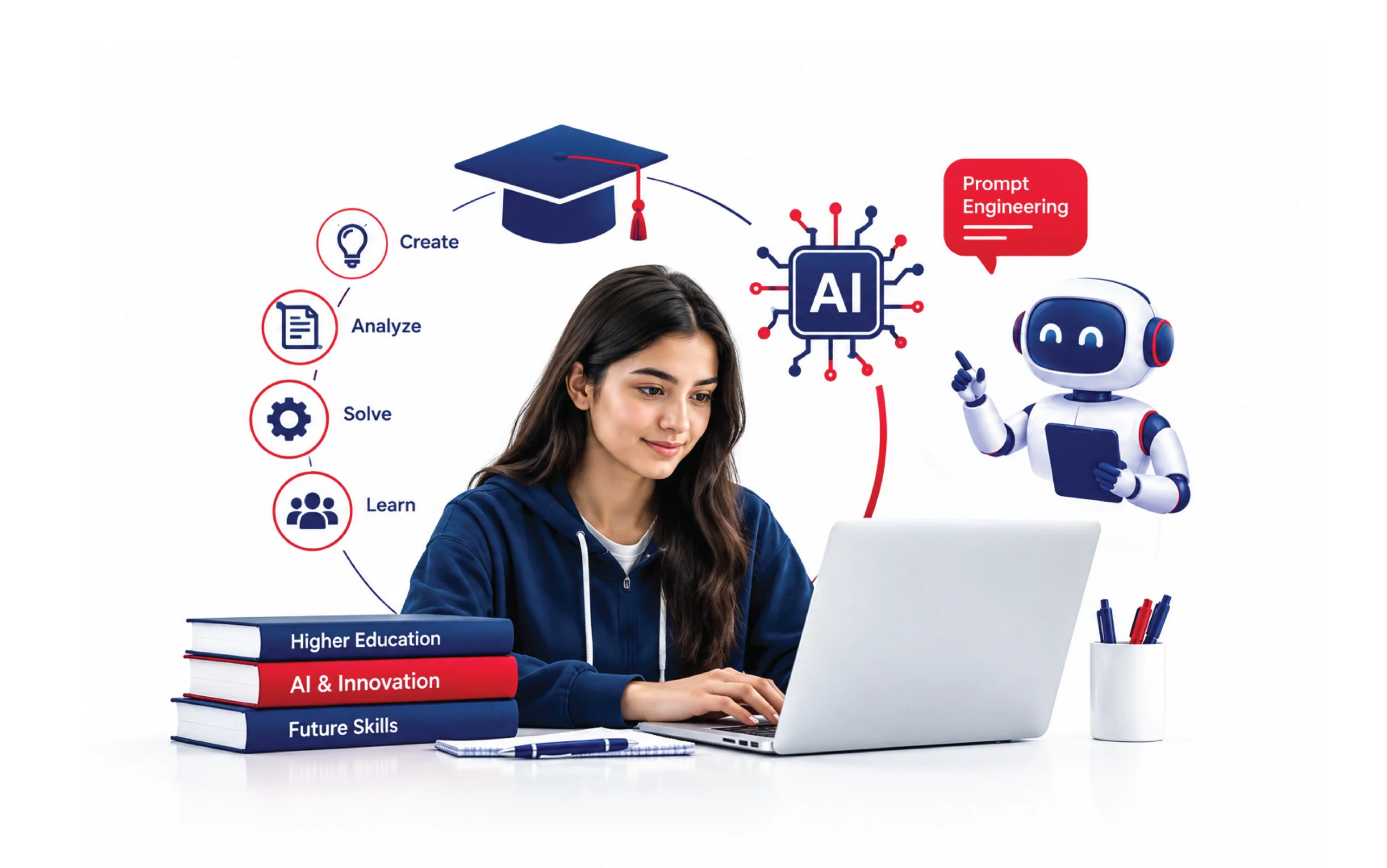

Artificial intelligence is rapidly changing how organisations operate, how professionals solve problems, and how knowledge is created and applied. From analysing information and automating routine processes to supporting research, communication, content development and decision-making, AI is becoming increasingly integrated into professional environments. As this transformation continues, higher education institutions face an important responsibility: preparing students with skills that remain relevant beyond the classroom.
Traditional academic knowledge continues to provide an essential foundation, but students increasingly need to combine subject expertise with practical digital capabilities. The ability to understand AI systems, communicate effectively with them, evaluate their outputs and apply them responsibly is becoming relevant across a growing range of professions.
The World Economic Forum’s Future of Jobs Report 2025 highlights the scale of this change. Employers surveyed for the report expect 39% of workers’ existing skill sets to be transformed or become outdated by 2030, while AI and big data are identified among the fastest-growing skills. The report also emphasises the importance of continuous learning, upskilling and reskilling as technology changes the nature of work.
For higher education, this creates a clear curriculum challenge. Students need opportunities to develop practical AI literacy alongside the academic and professional knowledge already provided by their programmes.
One particularly relevant capability is prompt engineering. Effective interaction with generative AI involves more than simply asking a chatbot a question. It requires students to understand the task, provide relevant context, define constraints, communicate the desired outcome and refine instructions based on the results. When taught as a structured skill, prompt engineering can support problem-solving, communication, critical evaluation and responsible human-AI collaboration.
Why Applied AI Skills Are Becoming Essential
AI is influencing professional activities across sectors rather than remaining limited to specialised technology roles. A business graduate may encounter AI-supported market analysis, a marketing professional may use generative AI for content workflows, a designer may work with generative tools, and an educator may use AI-assisted systems for teaching and assessment activities.
This does not mean that every graduate needs to become an AI engineer. Instead, students need an appropriate level of AI literacy for their chosen discipline.
The distinction between knowing about AI and knowing how to apply it is increasingly important. Students may understand basic AI concepts but still lack experience using AI tools to solve realistic problems, evaluate outputs or incorporate AI into professional workflows.
Applied AI skills education can address this gap by connecting technology with discipline-specific learning. Students can learn how AI works at an appropriate level, where it can contribute value, where its limitations lie and how human judgement should remain part of the process.
Prompt engineering fits naturally into this approach. Students can learn how to break a complex task into smaller components, establish context, provide examples, specify output requirements and refine prompts through iterative evaluation. These practices can encourage students to approach AI systematically rather than treating it as a source of instant answers.
The World Economic Forum also identifies analytical thinking, creative thinking, technological literacy, resilience and lifelong learning among skills that remain important as technology changes. This reinforces the idea that effective AI education should combine technological capabilities with human judgement rather than treating AI as a replacement for broader professional skills.
The Practical AI Literacy Gap in Higher Education
Higher education curricula are designed to provide students with disciplinary knowledge, theoretical foundations and professional preparation. However, the pace of AI development can make it difficult for established curricula to respond quickly to emerging workplace practices.
A student can graduate with strong subject knowledge but have limited experience applying that knowledge through contemporary AI-enabled workflows. A programme may discuss digital transformation without giving students structured opportunities to practise using AI tools within realistic academic or professional scenarios.
This can create a gap between academic preparation and workplace expectations.
The solution is not necessarily to replace existing subjects with AI-focused content. Instead, institutions can identify where AI competencies strengthen existing programme outcomes. The appropriate level of AI education will vary between disciplines.
A computing programme may require technical AI development skills, while a business programme may focus more on AI-supported analysis and decision-making. A communications programme may explore responsible AI-assisted content development, while an education programme may examine AI-supported teaching, assessment and academic integrity.
This discipline-specific approach allows institutions to introduce practical AI literacy without weakening the academic foundations of existing programmes.
It also prevents prompt engineering from being treated as a short-lived technology trend. Rather than focusing exclusively on specific AI tools or collections of prompts, institutions can teach transferable skills such as task decomposition, contextual reasoning, output evaluation, critical thinking and responsible technology use.
Designing an Applied AI Curriculum
There is no single model for introducing AI into higher education. Institutions can choose approaches according to their existing programmes, resources and learning objectives.
One option is a dedicated applied AI course. Such a course could introduce students to generative AI, prompt design, AI-assisted workflows, responsible AI use, output evaluation and practical applications relevant to their discipline.
Another approach is to integrate AI modules into existing courses. A business programme could include AI-supported market research and business analysis. A marketing programme could explore AI-assisted campaign development and content planning. A design programme could examine generative tools alongside creative strategy and responsible use. An education programme could investigate AI-assisted teaching resources and assessment practices.
Cross-disciplinary modules can provide another useful model. Students from different fields could work together on practical projects that require them to apply AI to real-world problems. This can demonstrate that the same technology may have different applications depending on professional context.
A strong prompt engineering curriculum should focus on the thinking process behind effective AI interaction. Students can practise defining objectives, providing context, establishing constraints, requesting appropriate formats and evaluating the quality of generated responses.
For example, instead of simply asking an AI system to produce a report, students could be taught to define the intended audience, provide relevant background information, specify the required structure, identify limitations and then evaluate the output against academic or professional standards.
This approach makes prompt engineering part of a broader competency framework rather than a collection of shortcuts.
Connecting AI Curriculum to Learning Outcomes
AI integration becomes more meaningful when it is connected to measurable learning outcomes.
Institutions can identify what students should actually be capable of doing after completing an AI-related module. Outcomes might include evaluating AI-generated information, designing effective prompts for discipline-specific tasks, identifying limitations and bias, applying AI responsibly within professional workflows, or explaining and defending decisions made while using AI.
This is consistent with the quality principles reflected in IQA-US programme certification. The organisation’s Program Certification page describes evaluation of specific academic or vocational programmes against competency-based standards and industry expectations, including defined learning outcomes, structured curriculum frameworks and alignment with workforce requirements.
This provides an important perspective for institutions considering AI curriculum development. AI should not be added simply because it is popular. Its inclusion should have a clear educational purpose and contribute to measurable competencies.
The same principle applies when institutions review existing programmes. As workplace expectations evolve, curriculum teams can examine whether existing learning outcomes still reflect relevant professional competencies and whether students have sufficient opportunities to practise those competencies.
Preparing Faculty for AI-Enabled Education
Curriculum transformation depends on faculty readiness. Institutions may have access to advanced AI tools but struggle to use them effectively if educators have limited opportunities to develop their own AI literacy.
Faculty development should therefore be considered alongside curriculum development. Educators can benefit from training that covers AI capabilities, limitations, prompt design, responsible use, academic integrity, privacy and discipline-specific applications.
Faculty members do not need to become technical AI specialists in every area. They need sufficient understanding to guide students, establish appropriate expectations and evaluate AI-supported work.
Academic governance is equally important. Institutions need clear policies explaining acceptable AI use, disclosure expectations, data protection and academic integrity. Students should understand when AI assistance is permitted, when independent work is required and how AI-supported work should be evaluated.
IQA-US places academic integrity and responsible assessment within its governance framework. Its Governance page states that institutions are expected to conduct assessments fairly, protect student data and uphold academic integrity, while candidates are expected to complete examinations independently and avoid malpractice or external assistance.
These principles become increasingly relevant as AI tools become easier for students to access.
Rethinking Assessment in the AI Era
The availability of generative AI also creates new considerations for assessment. If students can access AI tools while completing assignments, institutions need assessment methods that provide meaningful evidence of student competence.
This does not mean traditional assessment methods must disappear. Instead, institutions can place greater emphasis on application, reasoning, evaluation, reflection and demonstrated competence.
Students might be asked to evaluate an AI-generated response, identify inaccuracies, improve the output and explain the reasoning behind their changes. They could also document their process, compare alternative approaches or demonstrate how AI was used within a defined academic task.
Such methods assess more than the final answer. They examine whether the student understands the subject, can use AI appropriately and can exercise independent judgement.
This aligns closely with the direction of IQA-US’s Smart Assessment Framework. Its current assessment platform combines AI-driven tools with expert-designed questions and is designed around practical knowledge, competency and industry relevance. The platform also includes controlled online examinations, OTP verification, timed controls, randomized question selection, automated result calculation and system-generated reports.
For institutions introducing AI into their curricula, assessment integrity should therefore be treated as part of curriculum design rather than as an issue addressed after implementation.
Benefits for Students and Institutional Relevance
A well-designed AI curriculum can strengthen the relationship between academic learning and evolving professional environments.
Students can gain experience applying technology to realistic tasks while developing broader capabilities such as analytical thinking, communication, critical evaluation and problem-solving. This can help them demonstrate not only what they know, but how they can apply their knowledge in technology-enabled professional settings.
For institutions, curriculum modernisation can demonstrate responsiveness to changing workforce requirements. Programmes that regularly review learning outcomes, competencies and assessment methods are better positioned to remain relevant as professional expectations evolve.
This is particularly important because AI development is unlikely to follow a fixed path. Tools will change, new applications will emerge and some current techniques may become outdated. Institutions therefore need a quality framework that supports continuous review rather than relying on one-time curriculum updates.
IQA-US’s governance framework includes a Continuous Improvement Cycle built around annual reporting, periodic review, benchmarking and feedback.
This type of continuous approach is highly relevant to AI education. Institutions can monitor whether AI-related learning outcomes remain appropriate, whether faculty require additional support, whether assessment methods continue to demonstrate competence and whether programme content remains aligned with professional expectations.
Challenges Institutions May Face
AI integration will require careful planning. One major challenge is the speed of technological change. AI platforms can develop faster than conventional curriculum review cycles, making it difficult for institutions to maintain highly tool-specific courses.
A sustainable approach is therefore to prioritise transferable capabilities. Prompt design, critical evaluation, ethical reasoning, information verification and responsible human-AI collaboration can remain relevant even when individual tools change.
Faculty training is another challenge. Educators need time and institutional support to explore new technologies, redesign learning activities and understand emerging assessment issues. Without sufficient support, AI adoption may become inconsistent between programmes or departments.
Resources can also affect implementation. Institutions may need appropriate software access, faculty development programmes, secure digital environments, updated policies and revised assessment methods.
Data protection is another consideration. Students and staff should understand the risks of entering confidential, personal or sensitive information into external AI systems. Institutional policies should provide clear guidance about responsible data use.
Finally, institutions need to balance innovation with academic standards. The objective should not be to introduce AI simply because it is new. Instead, institutions should determine where AI contributes genuine educational value and establish appropriate quality controls around its use.
Keeping Higher Education Relevant in an AI-Driven Future
The growth of AI presents higher education with an opportunity to strengthen the connection between academic learning and the evolving world of work.
Institutions that integrate applied AI thoughtfully can give students opportunities to understand emerging technologies while continuing to develop the human capabilities that remain essential to professional success. Prompt engineering can form one part of this development by teaching students how to communicate with AI systems systematically, evaluate their outputs and apply them within defined academic or professional contexts.
At the institutional level, successful implementation requires more than adding an AI module. Curriculum design, learning outcomes, faculty readiness, assessment integrity, academic governance and continuous quality improvement all need to work together.
For higher education leaders and curriculum designers, the priority should therefore be practical and purposeful AI integration. Programmes should prepare students to work with technology while maintaining critical thinking, professional judgement, ethical responsibility and subject expertise.
As workplace skills continue to evolve, higher education institutions have an opportunity to make AI literacy part of a broader commitment to relevant, competency-based and continuously improving education.
Explore how to bring applied AI education into your institution next