
A qualification can influence hiring decisions, admissions, professional opportunities, and an individual’s ability to demonstrate their knowledge and skills. When a credential is presented as evidence of education or professional training, its authenticity becomes critical. Employers, educational institutions, certification bodies, and other stakeholders need confidence that a qualification was genuinely earned and issued through a legitimate system.
Credential fraud can undermine that confidence. Fraud may involve falsely claiming a qualification, altering certificate information, presenting fabricated documents, or misrepresenting the institution associated with a credential. When these practices go undetected, they can create risks for employers while weakening trust in legitimate qualifications.
Research from Prospects Hedd found that 49% of large businesses and 48% of SMEs surveyed had encountered a candidate who lied about their degree qualifications. The findings highlight why organizations need reliable methods for checking academic and professional credentials rather than relying solely on documents presented by applicants.
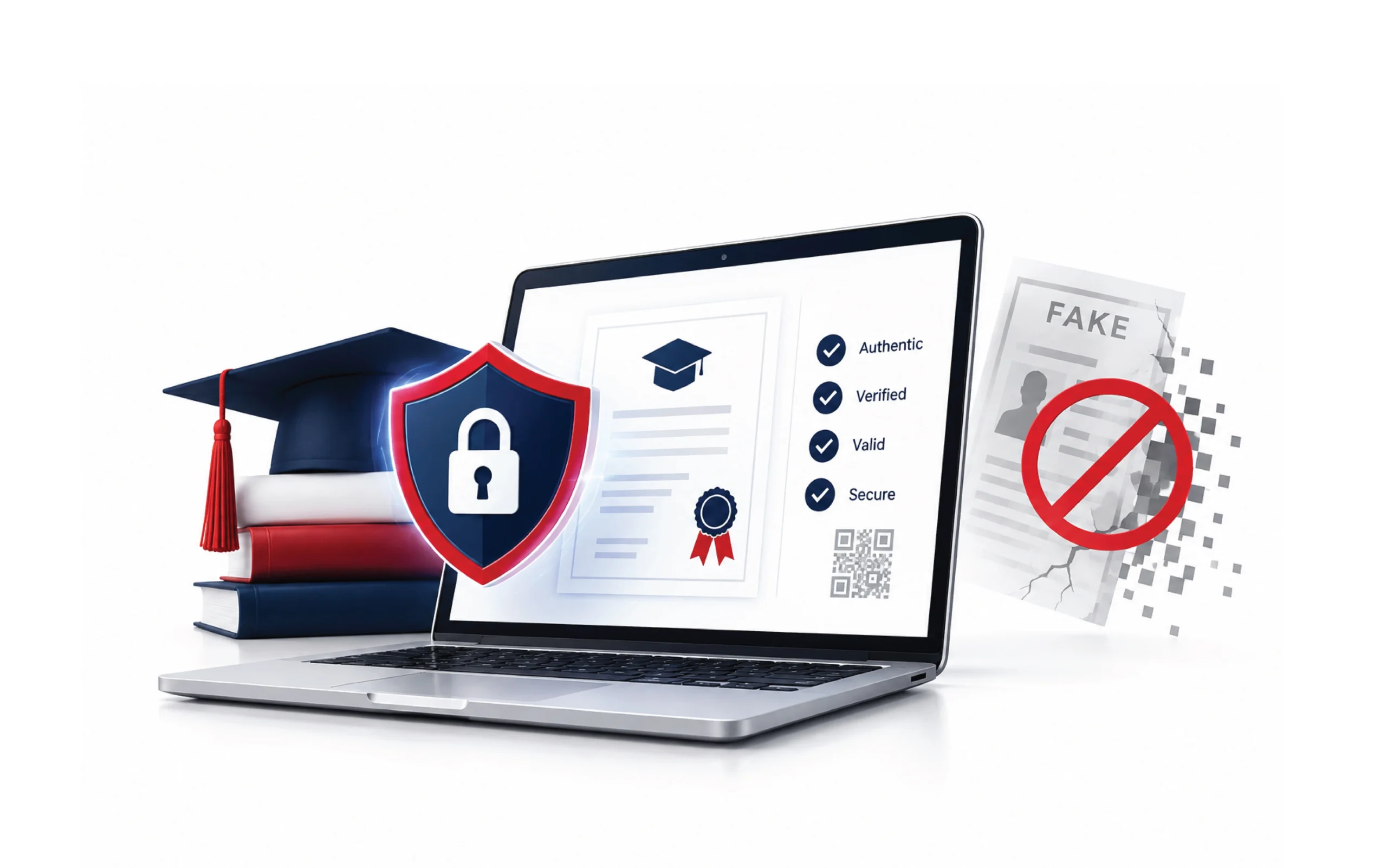
The challenge is particularly relevant as education and certification become increasingly digital. Digital documents are convenient to share, but their appearance alone does not prove authenticity. A secure digital verification portal can provide a stronger approach by connecting credentials to official records and allowing authorized stakeholders to confirm qualification information.
Understanding the Nature of Credential Fraud
Credential fraud can take several forms. An individual may claim to hold a qualification they never earned, alter the details of a genuine qualification, present a fabricated certificate, or provide misleading information about the institution associated with a credential.
The increasing use of digital documents has made qualifications easier to store and share, but it has also created opportunities for documents to be copied, edited, or misrepresented. A PDF certificate, scanned document, or digital image can be circulated without providing an independent method of confirming whether the underlying qualification is genuine.
This creates an important distinction between document presentation and credential verification.
Document presentation involves providing a certificate as evidence of a qualification. Credential verification involves checking whether that qualification corresponds with an authentic record maintained by an appropriate organization.
This distinction matters particularly during recruitment. Employers need to evaluate qualifications efficiently while maintaining confidence in the information provided by candidates. When verification depends entirely on examining documents or contacting institutions individually, the process can become time-consuming.
A digital verification system can provide a structured pathway for checking credentials against an official source.
Why Credential Fraud Damages Trust
The effects of fraudulent credentials extend beyond the individual presenting them. Employers can face financial, operational, reputational, and compliance risks when decisions are made using inaccurate qualification information.
The consequences can be especially significant when a position requires specific technical knowledge, professional competence, or formal training. A false qualification can create uncertainty about whether an individual actually possesses the knowledge or skills represented by the credential.
Credential fraud can also affect educational institutions and certification bodies. When fraudulent documents become more common, organizations may become more cautious about qualifications generally. This can make it more difficult for legitimate credential holders to demonstrate the authenticity of their achievements.
For genuine learners, a qualification represents time, effort, education, assessment, and achievement. A trustworthy credentialing system should help distinguish legitimate qualifications from unsupported claims.
Credential fraud prevention therefore protects more than individual organizations. It supports confidence in the wider education, training, and employment ecosystem.
IQA-US places academic integrity, secure certification verification, and credential transparency within its broader quality framework. Its official materials describe digital credentials and verification processes as mechanisms that support confidence in qualification authenticity.
How a Digital Verification Portal Works
A digital verification portal provides an online method for checking whether a credential corresponds with an official record.
IQA-US provides a secure online Verification Portal through which stakeholders and employers can verify student qualifications using a unique certificate number. This gives the verifier a specific reference point for locating the corresponding credential record.
A verification process based on a unique certificate number provides a stronger pathway than simply reviewing a certificate image. The verifier can use the identifier to check the qualification through the relevant official system.
IQA-US also uses Authorized Training Centre Codes within its verification framework. This provides additional institutional context when evaluating credentials associated with approved training centers.
The result is a more structured approach to verification. The credential becomes connected to an identifiable record and, where applicable, to the institution associated with the qualification.
This approach can make credential verification more practical for employers and other authorized stakeholders while providing credential holders with a way to demonstrate that their qualifications can be independently checked.
Why Unique Credential Identification Matters
A unique certificate number is an important component of digital credential verification.
Without a unique identifier, it can be difficult to distinguish one credential from another or determine whether a particular document corresponds with an authentic record. A unique ID creates a specific reference point for an individual qualification.
This also makes the verification process more consistent. Instead of relying on the design, logo, signature, or formatting of a certificate, a verifier can use the credential identifier to locate the relevant record within an official system.
IQA-US specifically states that its Verification Portal allows employers and stakeholders to verify student qualifications using unique certificate numbers. Its digital credential framework also emphasizes unique certificate identification numbers and digitally verifiable credentials.
For credential holders, this provides an additional layer of confidence that their qualifications can be authenticated when presented to employers or other authorized organizations.
What Makes a Verification System Genuinely Secure
A verification page alone does not automatically make a credential system secure. A superficial system may simply display a digital version of a certificate without establishing a reliable connection between the document and an authoritative credential record.
Meaningful secure certificate verification requires a connection between the credential, its unique identifier, the relevant institution or certification body, and the official verification record.
Authoritative verification is one of the most important elements. The verification process should take place through an official or authorized platform connected to the organization responsible for the credential.
Unique identification is another essential element. Each credential should have a reliable identifier that allows the verifier to locate the appropriate record.
Record integrity is equally important. Information displayed during verification should come from reliable records maintained by the organization responsible for the credential.
Institutional context can provide another layer of confidence. When appropriate, the verification system should make it possible to identify the institution or training provider associated with the credential.
Assessment integrity is also connected to credential security. Verification begins after a qualification has been issued, but the credibility of that qualification depends partly on the processes used to assess the learner before certification.
IQA-US describes secure authentication protocols, transparent grading mechanisms, secure digital assessment systems, and verification processes within its quality framework. These elements connect assessment integrity with credential credibility.
Digital Verification and Assessment Integrity
Credential verification should not be viewed as an isolated activity that begins only after certification.
The reliability of a qualification depends partly on how learners are assessed and how results are recorded before a credential is issued. If assessment systems lack appropriate controls, verifying the final certificate cannot address every potential integrity concern.
IQA-US describes digital assessment systems that incorporate secure authentication protocols and transparent grading mechanisms. Its framework connects these processes with the integrity of certification.
This creates a relationship between assessment and verification. Learner identity can be appropriately managed, performance can be evaluated against defined criteria, and the resulting qualification can be recorded and linked to a verifiable credential.
When these stages are connected, digital verification becomes part of a broader quality assurance process rather than simply functioning as an online certificate lookup tool.
The Difference Between a Digital Certificate and a Verifiable Credential
A digital certificate and a verifiable credential are not necessarily the same thing.
A digital certificate may simply be an electronic version of a traditional document. It can be convenient to store and share, but its digital format alone does not establish authenticity.
A verifiable credential provides a mechanism through which the underlying qualification can be checked against an appropriate record.
IQA-US describes its credentials as digitally verifiable and provides an online verification portal that allows employers and stakeholders to check qualifications using unique certificate numbers. Its official materials also identify protection against credential fraud, secure credential validation, online verification access, and transparency in certification records as benefits of its digital credential approach.
This distinction is important for organizations evaluating digital credential systems. The value of a credential does not come simply from being available electronically. Its value is strengthened when its authenticity can be independently confirmed through an appropriate verification mechanism.
Benefits for Employers
Employers are important users of credential verification systems. During recruitment, academic and professional qualifications can form part of the evidence used to evaluate whether an applicant meets the requirements of a role.
A reliable digital verification portal can provide employers with a practical method for confirming that qualification information corresponds with an official record.
This can reduce dependence on candidate-submitted documents alone. Instead of treating a certificate image or PDF as conclusive evidence, employers can use the relevant verification process to check the credential.
A consistent digital verification pathway can be particularly useful for organizations that recruit candidates from different institutions or regions. It provides a structured method for checking qualifications without requiring every verification request to follow a completely different process.
Digital verification does not replace professional judgment or other recruitment checks. It provides an additional source of evidence that can support more reliable qualification validation.
IQA-US explicitly identifies employers and stakeholders as users of its Verification Portal, allowing them to verify student qualifications through unique certificate numbers.
Benefits for Certification Bodies
Certification bodies have a responsibility to protect the credibility of the qualifications they issue or support.
A secure verification system provides stakeholders with a reliable way to confirm credential authenticity. It also creates a clear connection between issued credentials and official records.
For certification organizations, this contributes to protecting the wider value of their credentialing framework. When qualifications can be verified through an established system, employers and other stakeholders have greater confidence that the credentials can be traced to an authentic source.
Digital verification can also complement broader quality assurance practices. Accreditation, assessment standards, institutional evaluation, certification, and credential verification can work together to create a more comprehensive approach to quality and trust.
IQA-US’s accreditation and certification framework incorporates areas such as assessment integrity, quality assurance, secure verification, and certification processes. Digital credential verification therefore forms part of a wider approach to maintaining credential credibility.
Benefits for Educational Institutions and Training Providers
Educational institutions and training providers also benefit from reliable digital verification.
A transparent verification system allows institutions to demonstrate that qualifications associated with their programs can be connected to an established credentialing framework. This can support confidence among learners, employers, and other stakeholders.
Verification can also help legitimate institutions distinguish their credentials from unsupported or misleading claims. When stakeholders have access to an official verification method, they do not have to rely entirely on the appearance of a certificate.
IQA-US’s accreditation framework emphasizes areas including institutional accountability, academic integrity, assessment integrity, and quality assurance. These principles support the broader objective of maintaining confidence in educational and professional credentials.
Digital verification can therefore function as one part of an institution’s broader quality and credibility framework.
Benefits for Credential Holders
Credential holders have a direct interest in secure verification.
A qualification represents an individual’s learning, assessment, and achievement. When employers and institutions can verify it through an official system, the credential holder has a stronger method of demonstrating authenticity.
Digital verification can also make qualifications easier to validate when physical certificates are unavailable or when the verifier is located in another region.
IQA-US identifies protection against credential fraud, secure credential validation, online verification access, and transparency in certification records among the benefits associated with its digital credentials.
For genuine qualification holders, this can help protect the credibility of their achievements while making the verification process more accessible.
Why Superficial Verification Is Not Enough
One of the biggest weaknesses in credential verification is confusing document inspection with genuine authentication.
A certificate can contain a logo, seal, signature, serial number, or professional design and still require independent verification. Digital documents can also be copied or modified.
Secure certificate verification should therefore focus on the underlying credential record rather than the visual appearance of a document.
A stronger process connects the credential to an authoritative source, provides a unique identifier, and gives the verifier an appropriate method of confirming the information.
The central principle is that a credential should be verifiable because it exists within an authoritative system, rather than simply because it looks authentic.
This distinction becomes increasingly important as digital tools make it easier to create convincing documents and application materials. Verification systems need to assess the authenticity of qualifications rather than relying solely on how professionally a credential appears.
Building a Stronger Credential Fraud Prevention Framework
Credential fraud prevention works best as a connected system rather than as a single security feature.
The process begins with appropriate assessment and authentication. It continues through transparent evaluation, secure certification, accurate record management, and accessible verification.
Each stage contributes to the credibility of the final credential.
A secure digital verification portal then provides an important checkpoint through which employers and other authorized stakeholders can confirm the credential.
This creates continuity between assessment, certification, record management, and verification.
For institutions and certification bodies, this means credential verification should be considered part of the overall quality and integrity framework. For employers, it means qualification checks can go beyond simply requesting a certificate from an applicant.
Preparing for the Future of Digital Credentials
Education and certification are becoming increasingly digital. Learners can study remotely, institutions can operate across geographic boundaries, and employers can evaluate candidates from different regions.
These developments create opportunities while also increasing the importance of reliable credential verification.
As credentials become easier to issue, store, and share electronically, organizations need systems that preserve trust alongside convenience. A digital verification portal can help achieve this by providing a structured mechanism for confirming qualifications.
The future of credentialing is therefore not simply about replacing paper certificates with digital documents. It is about creating credentials that are easier to authenticate, trace, and verify.
IQA-US’s framework reflects this direction by combining accreditation, assessment, certification, digital credentials, and secure verification within its broader quality approach.
For organizations responsible for education, training, certification, or recruitment, developing reliable verification processes can help maintain confidence as the credentialing environment continues to evolve.
Protecting Trust in Legitimate Qualifications
Credential fraud can create risks for employers, institutions, certification bodies, and genuine qualification holders. It can weaken confidence in recruitment decisions and make legitimate educational and professional achievements more difficult to distinguish from unsupported claims.
Secure digital verification provides a practical way to address an important part of this challenge.
A strong digital verification portal should connect credentials to authoritative records, use unique identifiers, support appropriate authentication, provide institutional context, and make verification accessible to authorized stakeholders.
IQA-US’s approach incorporates these principles through its secure Verification Portal, unique certificate numbers, digital credentials, secure authentication protocols, and credential verification framework. Its official materials also identify protection against credential fraud as a benefit of digital credential verification.
For employers, this can provide a more reliable way to check qualifications. For certification bodies and institutions, it can strengthen transparency and help protect the credibility of their credentials. For learners and graduates, it can provide greater confidence that their legitimate achievements can be independently verified.
As education and employment become increasingly digital, verification will remain an important part of maintaining trust. Credentials should not only be issued and shared; they should be supported by reliable systems that allow their authenticity to be confirmed.
Explore how digital verification protects your credentials