
For training providers, establishing trust and demonstrating quality are essential parts of building a successful education organisation. However, many institutions and learners are often unclear about the difference between accreditation and government licensing. While both are important forms of recognition, they serve different purposes and should be understood as complementary not interchangeable.
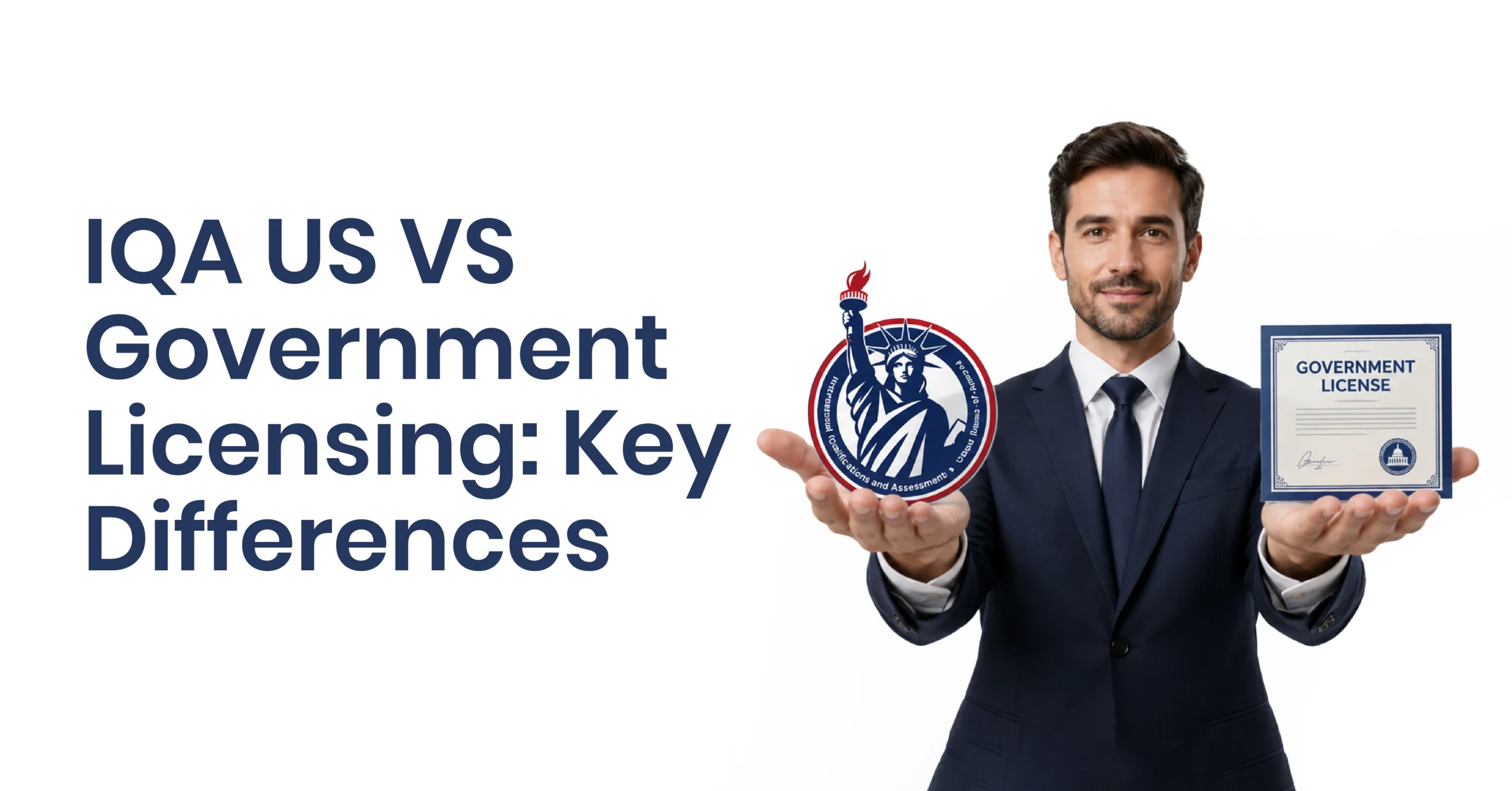
IQA US accreditation and government licensing address two different questions. Licensing focuses on whether an institution has the legal authority to operate, while accreditation focuses on whether the institution demonstrates recognised standards of quality, accountability, and continuous improvement.
Understanding how these two systems work together helps training providers communicate their value clearly and ensures that learners receive accurate information about institutional recognition.
What Is Government Licensing?
Government licensing is the official approval granted by a government authority or regulatory organisation that allows an education or training provider to operate within a specific legal framework.
The purpose of licensing is to ensure that institutions meet the basic requirements established by law. Depending on the jurisdiction, this may include requirements related to registration, organisational structure, financial responsibility, facilities, staffing, student protection, and operational compliance.
Where government approval is mandatory, a provider must obtain the necessary licence or registration before delivering education or training services. Licensing provides assurance that an institution has satisfied the minimum legal conditions required to operate.
However, licensing alone does not always provide a detailed evaluation of an institution’s educational quality, teaching practices, or commitment to continuous improvement.
What Is IQA US Accreditation?
IQA US institutional accreditation is an independent review process designed to recognise institutions that demonstrate a commitment to quality education and effective organisational practices.
Rather than granting permission to operate, accreditation evaluates how an institution manages and delivers its educational services. The review process considers areas such as governance, academic policies, learner support systems, assessment processes, staff qualifications, quality assurance procedures, and improvement strategies.
Achieving IQA US accreditation demonstrates that an institution has voluntarily undergone an external evaluation and has met established standards designed to support quality, transparency, and institutional effectiveness.
Accreditation Does Not Replace Government Licensing
One of the most important points for training providers to understand is that IQA US accreditation does not replace government licensing, statutory approval, or regulatory requirements.
Accreditation and licensing have different roles. An accredited institution may still need to obtain government authorisation if the laws of its country, state, or region require it. Similarly, holding a government licence does not automatically mean that an institution has undergone an independent accreditation review.
Training providers remain responsible for understanding and fulfilling all legal obligations that apply to their operations.
In simple terms:
- Government licensing confirms that an institution is legally allowed to operate.
- IQA US accreditation confirms that an institution has demonstrated recognised standards of quality.
Both are valuable, but they are not substitutes for each other.
How Accreditation and Licensing Work Together
A strong education system depends on both compliance and quality assurance. Government licensing provides the legal foundation for operation, while accreditation provides an additional layer of confidence by evaluating the institution’s commitment to educational excellence.
When used together, licensing and accreditation provide a more complete picture of an institution’s reliability.
For example, a training provider may be legally authorised to operate through government approval while also choosing to pursue accreditation to demonstrate stronger quality practices, improve internal systems, and provide additional confidence to learners and employers.
Together, they show that an institution:
- Operates within applicable legal requirements.
- Maintains structured quality assurance processes.
- Values transparency and accountability.
- Focuses on learner success and support.
- Is committed to ongoing improvement.
Why Institutions Pursue Accreditation Beyond Government Requirements
Even where government licensing is not required, many training providers voluntarily seek accreditation because quality recognition has become increasingly important in the education sector.
Learners want confidence that they are investing their time and resources in a credible institution. Employers want assurance that training providers deliver meaningful and reliable learning outcomes. Partners seek organisations that demonstrate professionalism and a commitment to recognised standards.
IQA US accreditation can help institutions:
- Build credibility and professional reputation.
- Increase confidence among learners and stakeholders.
- Demonstrate commitment to quality improvement.
- Strengthen internal policies and procedures.
- Create opportunities for collaboration and partnerships.
Accreditation is therefore not simply a certificate or status—it represents an institution’s ongoing commitment to maintaining and improving quality.
The Importance of Transparency in Institutional Recognition
Clear communication about accreditation and licensing helps build trust. Training providers should accurately explain what each form of recognition represents and avoid presenting accreditation as a replacement for government approval.
Being transparent about the difference between legal authorisation and quality recognition demonstrates professionalism and strengthens relationships with learners, employers, and partners.
Conclusion
IQA US accreditation and government licensing serve different but equally important purposes. Government licensing establishes an institution’s legal ability to operate, while IQA US accreditation provides independent recognition of its commitment to quality, accountability, and continuous improvement.
Rather than competing with each other, they work together to create a stronger foundation for trustworthy education and training. Institutions that maintain regulatory compliance while pursuing recognised accreditation demonstrate their dedication to both responsible operation and high-quality learning experiences.
For training providers, accreditation should be viewed as a valuable quality enhancement that complements—not replaces—the legal requirements established by government authorities.